
If we can sum up the respective levels of Chinese and British weapons and equipment during the Opium War in one sentence, that is, the British army is already in the firearms era of preliminary development, while the Qing army is still in the era of mixed use of hot and cold weapons.
People often refer to the Qing military firearms during the Opium War as “earth guns and earth guns”. If this only refers to the manufacturer, or even the manufacturing process, it seems reasonable, but in terms of the type of firearms, it is not. is a misunderstanding.
Gunpowder and tube-type firearms were invented in China, but China has always been in the pre-scientific period, and no scientific theory and experimental system have been formed, which has fundamentally restricted the development of Chinese firearms. By the time of the Opium War, the firearms used in the Qing Dynasty were not mainly invented and developed by China, but were made by imitating Western firearms such as the “Folang Machine”, “Bird Gun” and “Hongyi Cannon” introduced in the Ming Dynasty. , the Qing army used homemade old-fashioned “foreign guns and foreign guns”. As far as the burial style is concerned, compared with the British army, it is more than 200 years behind.
Qing Dynasty artillery
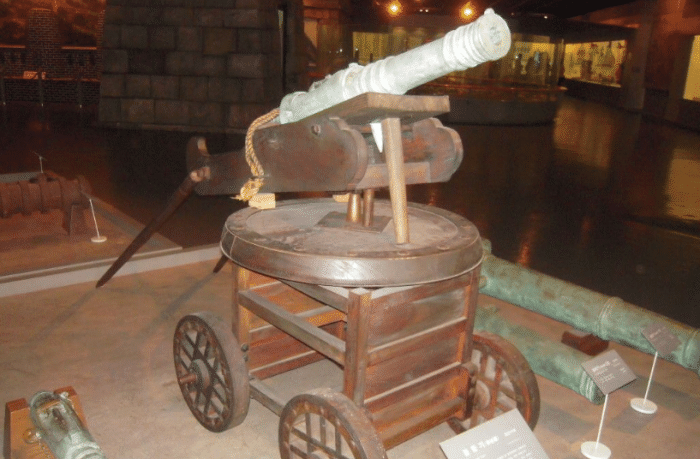
Artillery in the Qing Dynasty had various names. In the 21st year of Qianlong (1756), “The Imperial Order of the Ministry of Industry” listed 85 kinds of artillery with different names. The types of artillery in the Qing Dynasty were distinguished in the “General Examination of Qing Dynasty Literature”: according to the material, they are divided into iron, copper, iron core copper body, copper wood inlay, and iron gold ornaments; according to weight, they are divided into light and heavy two kinds. The new-type artillery at that time can be roughly divided into three types: red-clothed artillery, sky-rocketing artillery, and sub-unit artillery if comprehensively investigated in terms of the loading method and ballistic characteristics. In addition, there are traditional Chinese artillery such as the Shenji Cannon, and so on.
1. Types of red guns
The red-clothed cannon was a large-scale front-mounted artillery introduced from Europe in the late Ming Dynasty. This kind of artillery has a long barrel, and the ratio of barrel to caliber is more than 20:1; the tube wall is thicker, and gradually thickens from the muzzle to the breech, which can withstand greater bore pressure; the gun body is equipped with a front sight, According to the door, there are double cannon lugs in the middle, which are mounted on the gun frame, which can not only keep the gun body stable, but also can be pitched to control the range. , was the most powerful artillery at the time. Qing Dynasty artillery, mostly red gun type.
2. Types of skyrockets
The sky cannon is a short-barreled, large-caliber front-loaded smoothbore curved-firing artillery. The barrel length is only several times the caliber. It fires explosive bombs. Longest range. This kind of artillery is generally called “mortar” in the West because of its shape like a stone mortar. It is the predecessor of the mortar and is mostly used in field battles and siege.
3. Types of sub-cannons
The sub-cannon is a light rear-mounted artillery, which consists of a main cannon and several sub-cannons. “The child and mother guns are all cast iron, with a rich front and a back, and the bottom is like a cover.” In wartime, the sub-guns can be pre-loaded with ammunition, which can be loaded into the rear belly of the mother gun in turn, which can reduce the time for loading ammunition and improve the firing speed of the artillery. There are three main types of guns in the Qing Dynasty: the iron guns in the Kangxi period, the wooden handle guns and the odd guns in the Yongzheng period.
4. God machine gun type
The Shenji Cannon is a traditional Chinese artillery. Due to the lack of a sight and a rear sight, the shooting accuracy is limited. After the Folang machine and the Hongyi (clothing) gun were introduced into China, the Shenji gun has become backward, but it is still one of the main artillery equipment of the Qing army.
5. Other gun types
(1) Nine Sections Ten Cheng Cannons
In the thirteenth year of Qianlong (1748), it was made during the first military use of Dajinchuan. Copper. “Weight from seven hundred and ninety to seven hundred and ninety-eight, and length from five feet one inch to six feet nine inches… The medicines range from one catty four taels to one catty eight taels, iron two catties and eight taels, and four Wheels”. The feature of the gun is that the thickness of the front and rear of the barrel is the same, and it is divided into nine sections. Except for the muzzle of the first section and the end of the last section, one end of each section is male thread, and the other end is female thread.
In inconvenient mountains, rivers and lakes, it can be “divided to cover risks”, and can be combined into one during combat. A standing wood with a semi-circular notch is installed in the gun carriage, and the gun body is placed in the semi-circular notch. There is an iron column on the left and right of the standing wood, which clamps the gun body to make it stable. The right iron pillar is twice as long as the left iron pillar, the upper end is bent forward, and the sight is installed.
(2) Tiger tail gun
Built in the 60th year of Emperor Kangxi (1721), it is made of iron, with a total of 2 doors, “each three feet long, weighing twenty-seven catties, and lead weighing two taels”. The Huwei Cannon was the lightest cannon in the Qing Dynasty, and its specific shape is unknown.
(3) Letter Cannon
It is made of iron, tube-shaped, and the top and bottom are like one, “from 40 to 80 catties, and from one foot six inches to one foot eight inches long, without wedges, four uplifts, and eight taels of medicine”. The cannon is erected on the ground, loaded with gunpowder, and fired into the sky.
Guangxu’s “Da Qing Huidian Map” Volume I OO has “Xingying Xinbao Map”. The letter cannon is the artillery used to issue orders during military parades, training, emergencies and operations. In the 10th year of Shunzhi (1653), the “Certificate of Cannons” was set up in Baita Mountain, the capital. In the event of an emergency, a letter cannon was fired, and the officers and soldiers of the Eight Banners immediately put on their armor and carried their guns upon hearing the sound of the cannon, and rushed to the scheduled post, while the civilian officials rushed to the Meridian Gate to wait for orders.
(4) Taiwan Cannon
This cannon was made in the 22nd year of Kangxi (1683) in the war to unify Taiwan. The Qing army captured Zheng Jun’s artillery. It is from four feet three inches to one zhang and two inches in length, mixed with flower inscriptions, banana leaf inscriptions, and beast-shaped in pan-succubus, with Fanshu in the middle, ten uplifts, and double buttons in the middle of dragon inscriptions, which can be hung through the rope. Medicines are from 1 to 10 jin per jin, and iron from 2 to 20 jin.
(5) Back cannon
In the 24th year of Qianlong’s reign (1759), a light artillery piece was captured by the Qing army in the war to pacify Hezhuo and Daxing. Patterns, seven uplifts, plain iron lighters”, equipped with wooden saddles, carried by camels, etc.
Comparison of Chinese and British artillery
The prototype of the artillery used by the Qing army can be traced back to the Ming Dynasty. During the Kangxi period, Western missionaries such as Nan Huairen also helped the Qing Dynasty to supervise the production of many artillery pieces. Therefore, although the artillery of the Qing army has many names, in terms of style, it is mainly modeled after the Western cannon series from the 17th century to the early 18th century.
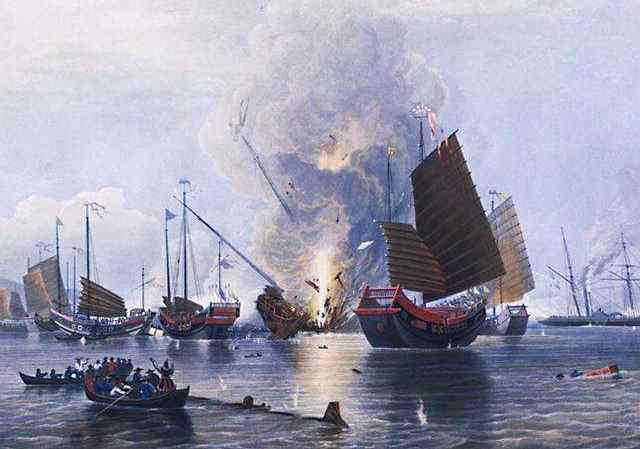
Since in the 18th century, there was no major change in the style of Western artillery, by the time of the Opium War in the 19th century, the artillery of the Qing army was basically the same in style and mechanism as the British army. The difference between the two lies in the quality problems caused by the manufacturing process. , manifested in the following aspects:
1. Poor iron quality
The industrial revolution changed Britain’s smelting technology and greatly improved the quality of iron, which provided good raw materials for casting high-quality artillery. The smelting technology in the Qing Dynasty was backward, the furnace temperature was low, the molten iron could not be purified, and there were many impurities. The cast artillery was very rough, with many pores and air bubbles. The Qing army mainly adopted two strategies for this problem. One is to thicken the wall of the artillery, making the artillery of the Qing army extremely cumbersome. The second is to use copper as a casting material. Due to the lack of copper resources at that time, copper cannons were very rare and regarded as sharp weapons. In addition, for the artillery that has been cast with many pores and bubbles and is easy to burst, the Qing army reduced the amount of gunpowder, which in turn reduced the power of the artillery.
2. The casting process is backward
At this time, the United Kingdom has used iron mold and other processes in casting, and used a boring machine to cut the inside of the gun barrel to make it smoother. The Qing Dynasty still used the backward clay mold technology at this time, the castings were rough, and the gun chambers were not processed in depth, resulting in disordered ballistics after the projectiles were fired, which reduced the shooting accuracy. At this time, due to scientific progress, the British side had carried out research on gunpowder combustion, ballistics, and initial velocity. The Qing side only copied the artillery, and did not understand the barrel/caliber ratio and the actual significance of the position of the fire door in the combustion of gunpowder. As a result, the proportions of many artillery pieces were inconsistent, and the fire doors of most of the artillery were too far forward and too large. .
3. Incomplete or imperfect gun mounts (gun carriages) and sighting devices
The gun mount (gun carriage) is a device for adjusting the firing direction and the angle of the artillery. The Qing army paid little attention to this. By the time of the Opium War, many artillery pieces of the Qing army had no mounts, but were fixed. Some gun mounts can only adjust the high and low angle and cannot move left and right, which limits the shooting range. Most of the gun mounts that have been set up are made of poor wood. After the blasting, the gun mounts are shaken loose, making it difficult to use. Surprisingly, many artillery pieces of the Qing army did not have sighting equipment, or only had “Xingdou” (to determine the direction of fire) and no “gun gauge” (to determine the angle between high and low). Soldiers aim mainly by experience.
4. There are few types of shells and the quality is poor
The shells used by the British army in this period include solid shells, shotgun shells, and blasting shells; while the Qing army has only one kind of solid shells with the worst efficiency, and has the defects of rough shells or small diameters.
In addition, the management of Qing artillery is like a shotgun, and there is no regular replacement system. Because they are not usually used, many artillery pieces placed in the open air in forts, battlements, etc., were exposed to the sun and rain, and the gun bodies were corroded. By the time of the Opium War, most of these artillery pieces had a long service life. Even the relics of the former Ming Dynasty. If it is not steamed and washed, try it. No one knows if it can be used.
From this, we can conclude that although the Chinese and British artillery styles are roughly the same, due to the difference in quality, they have defects such as short range, slow shooting speed, small shooting range, poor shooting accuracy, and weak shell power after hitting. Which of these flaws is not fatal?
The vast majority of battles in the Opium War were artillery battles between the Qing army’s shore artillery and the British army’s naval artillery. According to common sense, coastal guns rely on solid land, but regardless of factors such as weight and recoil, they can be made larger, with longer range and greater power. In fact, the shore artillery of the Qing army was generally heavier than the naval artillery of the British army. However, during the battle, the power of the artillery on both sides was reversed. When the smoke cleared on the battlefield, we had to face the tragic fact in dismay: the Qing army failed to sink a single British battleship or ship during the entire war, but its own position was severely damaged. Hundred holes.
Cannonball fills the gunpowder gap
During the Opium War, gunpowder in China and Britain was at the same stage of development, all of which were black pyrotechnic powder, the main components of which were nitrate, sulfur and charcoal. However, it is also because of quality problems that the gap between China and Britain in gunpowder is larger than that of the aforementioned artillery. The key here is science and industry.
In the fifth year of Daoguang (1825), after many experiments, Scheffleri proposed the best ratio of black powder. The ratio of nitrate, sulfur and charcoal was 74.84%, 11.84% and 11.32% as the best gunpowder. formula. According to this formula, the United Kingdom prepared gun powder (75% nitric acid, 10% sulfur, 15% carbon) and gun powder (78% nitrate, 8% sulfur, 14% carbon). These two formulas have been identified as standard gunpowder formulas by Western countries.
In addition to the theoretical advances brought about by science, the Industrial Revolution brought about mechanized production. Britain’s gunpowder at this time has been produced in modern factories, and it is in a leading position in the world.
China’s gunpowder originated from the accidental discovery of alchemy Taoists, which made the Chinese gunpowder theory covered with the yin-yang and five-element theory from the very beginning, hindering the scientific analysis of its physical and chemical phenomena. Since then, the development of gunpowder has mainly depended on the accumulation of experience, with little theoretical exposure. By the time of the Opium War, the gunpowder manufactured by the Qing army was still produced in handicraft workshops or workshops according to the formula in the late Ming Dynasty.
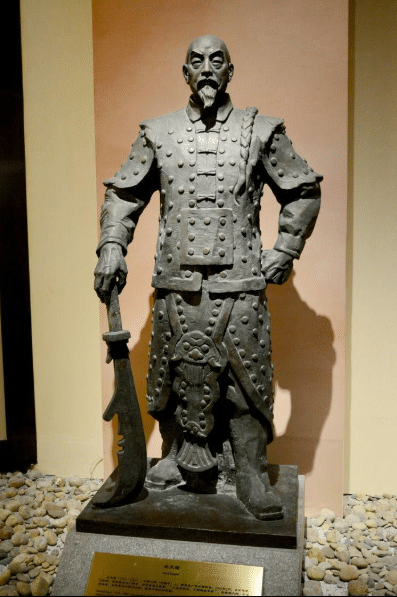
The gunpowder formula used by Guan Tianpei, the admiral of the Guangdong Navy before the war, was 80% nitrate, 10% sulfur, and 10% charcoal. This is the only recipe we can see during this period. However, the nitrate content in this formula is too high, which is easy to absorb moisture, inconvenient for long-term storage, and has low explosive effect.
The production method of handicraft industry makes it impossible for the Qing recipe to extract high-purity nitrate and sulfur, and the impurity content of the medicine is high. The particles are coarse and varied in size and often do not burn sufficiently.
The quality of gunpowder directly affects the power of guns and artillery.