
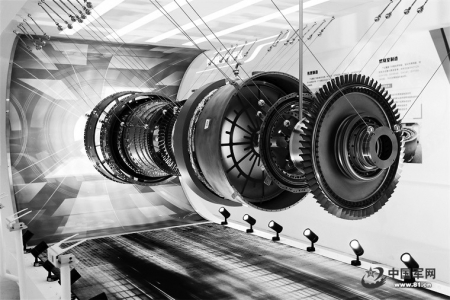
At the 13th China International Aviation and Aerospace Expo, the J-20 fighter jets shined in the sky. The Air Force spokesman proudly said that the J-20 fighter uses a “Chinese heart” – a domestic engine. Lifting the aero-engines of the fighter jets soaring into the sky embodies the hard work of generations of aviation developers. my country’s aviation engine business was born during the War to Resist U.S. Aggression and Aid Korea. Since the 1960s, in the face of the dilemma of “can’t get it, can’t buy it”, the people of China Aviation Development have just relied on their own hands to open up a road of independent research and development of aero-engines. Entering a new era, China’s aviation engine business has ushered in a new spring. In August 2016, China Aviation Engine Group (hereinafter referred to as China Aviation Development Corporation) was formally established.
Going forward to the great dream, in the new era, the people of Airfa will keep in mind the leader’s entrustment, with firmer self-confidence and firmer courage, on the road of casting a strong “Chinese Heart” of aviation power, and gather together forge ahead in the new journey and make contributions to the new era. Majestic power. Let us turn our attention from the front to the backstage, listen to the youth stories behind the fighter planes flying into the sky, and feel the spiritual feelings of generations of Airfare people forging “hearts” for the country.
A pair of “Hangfa couple”‘s life experiences——
If the Chinese want to be proud, the engine must become China’s “competition machine”
Inside the China Aviation Museum, a H-6 fighter jet, code-named 4251, stood proudly, and Zhou Xiaoqin, an old man in his 90s, quietly watched the fighter jet. This time, she was holding a yellowed newspaper in her hand, and an article on it read: “my country’s first hydrogen bomb air-explosion test was successful, and the era of China’s bullying is over!”
This newspaper is from more than 50 years ago. At that time, the young Zhou Xiaoqin didn’t understand why her husband kept it carefully. It wasn’t until a few years ago when she saw an old photo in the H-6 fighter documentary on TV that she suddenly realized and burst into tears.
The “protagonist” of this photo is the early domestic aviation engine “Turbojet-8”. At that time, after graduating from university, Zhou Xiaoqin resolutely chose the difficult Northwest China to become a technician in an engine factory. There, she recorded the two most important “meetings” in her life——
One is the “Turbojet-8” aero-engine, the first type of engine that Zhou Xiaoqin participated in tackling key problems, which embodies her and her colleagues’ efforts for many years; the other is Jin Yuanqing, Zhou Xiaoqin’s lover, and the two jointly participated in the development of the “Turbojet-8”. Aero-engine, and then hand in hand for decades.
To join the aviation engine business, Zhou Xiaoqin and Jin Yuanqing have the same goal: if the Chinese want to be proud, the engine must become China’s “winner”. At that time, machine tools and milling machines were scarce, and there were not enough beds for workers to sleep in. Jin Yuanqing took the technical backbones to lay the floor and sleep in the workshop, and fought on the front line day and night; Zhou Xiaoqin was on the scene, drawing drawings and adjusting equipment. girl”.
In 1967, the “Turbojet-8” was successfully trial-produced. It didn’t take long for the workers to say goodbye to the “Turbojet-8”. Most people don’t know the future whereabouts of “Turbojet-8”, and even Zhou Xiaoqin can’t find out any news from Jin Yuanqing’s mouth. More than 50 years later, from a H-6 documentary on TV, Zhou Xiaoqin learned the secret that Lao Jin kept for a lifetime. Their first “child” – “Turbojet-8” is very promising: as the power “heart” of the H-6, it participated in the implementation of the first hydrogen bomb air-explosion test mission in New China.
This is a great honorable and obscure cause. Generations of aviation developers live incognito behind the scenes, silently holding up fighter jets to take off.
The engine is the “heart” of the fighter, and the development of the engine is destined to be ahead of the fighter. Combing the history of China’s aviation engine development, “Qinling”, “Kunlun”, “Taihang”… These engine model names with unique Chinese characteristics show the determination and confidence of my country to independently develop the country’s most important weapon, and also contain the strong strength of generations of aviation developers. Profound feelings of serving the country with a strong army.
Perhaps, for a long time, no one will know their names, but whenever the war eagle takes off, they will write “Chinese romance” on the blue sky.
An innovative expedition like “climbing Mount Everest” —
It’s not okay to follow others at the same pace. To engage in aero-engines, you must innovate independently.
In 2018, at the site of the 12th China International Aviation and Aerospace Expo, the J-10B thrust vector demonstrator equipped with a vector nozzle flew into the sky, showing the world highly difficult stunts such as “Cobra” and “Falling Leaves”.
In the cheers of the crowd, Yin Zeyong, academician of the Chinese Academy of Engineering and director of the Science and Technology Committee of China Aviation Development Corporation, nodded in approval frequently, and his inner thoughts were full of thoughts. The expert, who is over 100 years old, is very aware of how difficult the road of my country’s aero-engine industry has been, and he is even more aware that there is still a long way to go. “It will take more than ten or twenty years to complete what others have done for dozens or nearly a hundred years. We have a lot of lessons to make up, and a lot of things to do. We can’t keep pace with each other, we must pioneer and innovate.” He said.
Aero-engine, known as the “jewel in the crown” of modern industry, is extremely difficult to remove. Some analysis shows that in terms of “value ratio per unit weight”, ships are 1, cars are 9, and aircraft engines are as high as 1,400.
This road is bound to be difficult. Since entering the industry, Yin Zeyong firmly believes that it is not enough to follow others in the same pace, and it is necessary to innovate independently in the development of aero-engines. With this belief, he has been working silently in the field of aero-engine research and development in my country for more than half a century. In a sense, the scientific research story of his and his colleagues’ hard work and determination to tackle key problems is a microcosm of the independent innovation of my country’s aero-engines.
At that time, if my country’s aero-engine industry followed the Soviet Union, doing surveying and mapping imitation seemed to be a shortcut, but Yin Zeyong led his colleagues to firmly embark on the road of independent innovation, and put the main energy into the development of structural strength, comprehensive optimization, compressors , turbine and many other applied basic research fields.
Opportunities are always reserved for those who are prepared. Since the 1990s, my country has accelerated the research and development of turboshaft engines. The achievements of Yin Zeyong and his colleagues in applied basic research accumulated over the years have played a key role. my country’s first self-developed turboshaft engine came into being.
“In terms of cutting-edge technology, we must move forward like climbing Mount Everest.” Yin Zeyong said to everyone earnestly, “Now everyone knows that the core technology of the engine can’t be asked or bought, but to walk your own way requires self-improvement and belief. And the dual blessing of innovative methods.”
Self-improvement tests fighting spirit, spirit and perseverance; innovation means loneliness, difficulties and setbacks. Along the way, Yin Zeyong and his colleagues have passed through the “no man’s land” of technological innovation, and won the “first” in many industries: the first type of turbofan engine designed and delivered in my country, the first type of turbofan engine The turboshaft engine independently developed and delivered for use, the first self-developed advanced large bypass ratio turbofan engine verification machine for large aircraft… With the joint efforts of all aviation developers, my country has become the fifth in the world capable of A country that independently develops aero-engines.
Over the years, AVIC has signed strategic cooperation agreements with more than 50 universities and enterprises, built more than 80 joint technology centers and laboratories, and built a large number of national-level scientific and technological innovation platforms. Every ten thousand people have 800 invention patents. multiple pieces.
This set of data is refracted on the aero-engine, and we see such a scene-
On July 30, 2017, at the military parade in Zhurihe, the multi-type fighters equipped with turbofan, turbojet, turboshaft, turboprop and other engines developed and produced by China Aviation Development Corporation were reviewed;
On October 1, 2019, at the military parade celebrating the 70th anniversary of the founding of New China, hundreds of sets of power products of China Aviation Development Corporation were reviewed…
When these pictures appear in front of the Chinese people again and again, the business card of my country’s aviation industry has also been refreshed and polished again and again: aiming at the goal of building an aviation power, the Chinese aviation industry is taking off and advancing at full speed.
An army of striving to forge “Chinese heart” in relay long-distance running——
Every day dancing in the wind is a warm tribute to life
According to the data, it takes about 20 years to develop a new cross-generation aero-engine. In all, it has been 71 years since the start of the new China aviation industry. Such a time point is in its prime for the world-class China Aviation Development Corporation. For individuals, 71 years is almost three generations of youth.
In 1947, Wu Daguan rejected the high-paying employment in the United States, and returned to China to participate in the preparation of the new China aviation industry with the ideal of “saving the country by aviation”. At the time of material science, he was only 23 years old; Zhang Enhe, the chief designer of the “Taihang” engine, was only 26 years old when he participated in the development of turbofan engines.
It is because of his infinite love and persistent pursuit of the aviation engine business that Wu Daguan wrote on the title page of his diary, “When will you bring out your products to dedicate to the party?” Career, willing to hide other colors”, leaving only “monochromatic rainbow”; Zhang Enhe “except for eating and sleeping is to dry the engine”, until the last moment of life, still running for the aviation engine business. From youthful youth to old age, they spent their whole lives to forge the “Chinese Heart”.
Zuo Zhijian is a welder. He is good at high-precision welding technology of aero-engines and has solved many technical problems successively. In order to solve the problem of welding deformation of titanium alloy large casing, he repeatedly tested and adjusted, made auxiliary devices, and worked out a complete set of operating procedures.
At another factory of the group, worker Hong Jiaguang is grinding engine blades. The diamond roller tools used by the workers were researched and developed independently by his team. This technology improves the blade processing accuracy to 0.003 mm, which is equivalent to one-twentieth of the hair, and they also won the second prize of the National Science and Technology Progress Award.
Like Hong Jiaguang, every Hangfa person has a “big country craftsman dream” in his heart. Li Ling, a post-90s welding technician. Her master is Xie Wenjun, who is one year older than her. When entering the industry, Xie Wenjun made a “ten thousand solder joints” agreement with her: “If you do anything, as long as you do it 10,000 times seriously, you can become an expert. I believe we can all be.”
Later, Li Ling participated in the IPC International Welding Competition and achieved good results as the runner-up in the global finals. Standing on the wider and wider stage, Li Ling can’t remember whether she has reached the “10,000 solder joints” that the master said, but she has never forgotten her original intention. Looking back, she wrote this sentence in the circle of friends: “Every day that dances in the wind is a warm tribute to life.” (Some names in the article are pseudonyms)
According to the People’s Liberation Army Daily