
This article is reproduced from: Hebei Daily
Focus on character growth and create group portraits of heroes
——A review of the movie “Volunteers: Battle of Life and Death”
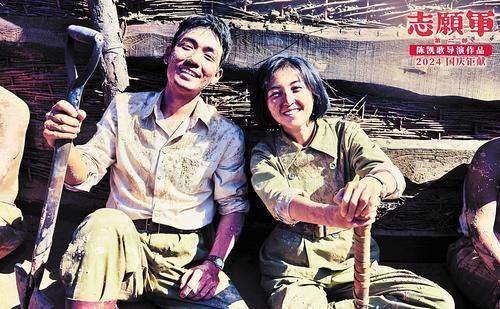
Poster for the movie “Volunteers: Battle of Life and Death”.
□Liu Menghan
The film “Volunteers: Battle of Life and Death”, which Hebei participated in the creation of, has received continued attention from the audience. According to data released by the National Film Administration on October 8, the film led this year's National Day schedule with a box office of 805 million yuan. As the second part of the “Volunteer Army” trilogy, the film focuses on the battle of life and death in the fifth battle of the War to Resist U.S. Aggression and Aid Korea – the Cheorwon Blockade, through the family ties of the three members of the Li family, the friendship among comrades, and the sacrifice of the soldiers to protect them. The national conditions of the defense line reflect the spirit of patriotism of the volunteer army officers and soldiers who regard the interests of the motherland and the people above all else and risk their lives for the dignity of the motherland and the nation. They are brave and tenacious and sacrifice their lives for the revolutionary heroism. The spirit of revolutionary optimism that maintains high morale, the spirit of revolutionary loyalty that generously dedicates everything one has to accomplishing the mission entrusted by the motherland and the people, and the spirit of internationalism that strives for the cause of peace and justice for mankind.
The movie “Volunteers: Battle of Life and Death” focuses the narrative on the Cheorwon Blockade where the power gap between the enemy and ourselves is very different. 25,000 Chinese People's Volunteers faced off against nearly 50,000 enemies. As the second film in the “Volunteer Army” series, the film does not directly continue the foreshadowing laid in the first film. Instead, it starts with a flashback and sets the time back to the summer of 1950. Shortly after the end of the Liberation War, the father Li Moyin and his son Li Xiang and his daughter Li Xiao's family reunited after a long separation. After a brief reunion, Li Xiang and Li Moyin rushed to the Korean battlefield, leaving Li Xiao alone. This kind of plot setting is not only a narrative of war, but also a true portrayal of countless families. Until Li Xiao also applied to go to the Korean battlefield, Li Xiang and Li Xiao unexpectedly reunited on the battlefield, pulling back the timeline, and the Cheorwon Blockade began.
As an important narrative clue of the film, the reunion and farewell of Li Moyin's family reflect the strong feelings of family and country. The film gives many close-ups of the home keys that Li Moyin and Li Xiao carry with them. The key not only represents their protection of their small home, but also symbolizes the volunteer army officers and soldiers' devotion to death to defend the security of the motherland and the interests of the people. They are sharp swords with an edge hidden in the sheath, and they can use their swords calmly when necessary. The names of the two characters Li Xiang and Li Xiao are full of romanticism, representing ideals and hopes. The small red flower named “Can't Die” given to Li Xiang by Li Xiao, even if it dries up, still exudes the smell of “good days”, and is passed on to the soldiers one by one. The little red flower represents the warmth and hope of hometown, expresses the family's expectations for the safe return of the volunteer soldiers, and symbolizes people's desire for peace in the cruel war. At the same time, it is also a belief in victory and an immortal spirit. As the story develops, Li Moyin is seriously injured and his whereabouts are unknown. Li Xiang fights until the last moment and sacrifices his life heroically. Li Xiao is like the little red flower that “cannot die”, representing the gentle and tenacious power of women on the battlefield. Perhaps their names have already revealed their destiny, and the realization of their ideals will not be a smooth road, but hope is there and will never fade away.
The two heavy rains in the film can be called a “magic touch”. The first night rain wet the soil and gave off a fishy smell, which aroused the soldiers' homesickness. That familiar smell is the gentle call of hometown, and it is also the motivation to fight with the enemy. It is similar to “Bashan Night Rain”. The second rain fell at the same time as the water from the Caochuan Reservoir, turning the trenches into a vast ocean, successfully blocking the enemy's heavily armed troops. The water carries the little red flowers that represent love and hope and float into the distance. In the distance, there is the hometown that the soldiers are nostalgic for, and their families are always concerned about them. The candy sent by a domestic child symbolizes the people’s deep care, encouragement and trust in the volunteer soldiers. The fate of the military and civilians is closely related. It was passed down within the Li family, from his father Li Moyin to Li Xiang, and then to Li Xiao. The candy wrappers finally drifted along with the little red flowers, symbolizing the small but firm belief of each individual in the long history.
Focus on character growth and adopt multi-line narrative. Against the grand narrative background of war, through delicate characterization and profound emotional depiction, the film shows the brilliance of human nature in war, emphasizing the growth and transformation of the “small self” in the process of rushing to the “big self”. The soldiers went from initial timidity and hesitation to final bravery and determination. This transformation is not only reflected in their initiative in fighting, but also in their inner maturity and deep understanding of their family and country.
Yang Chuanyu, who had survived the battle at Songgu Peak due to cowardice, returned to the battlefield with self-blame and regret. He confessed his former cowardice to the former deputy company commander Sun Xing, and volunteered to go to the Caochuan Reservoir to serve in the battle. He died heroically while covering his comrades in completing the task of opening the gate. Battle damage recorder Yang Sandi has grown from a recruit who lacked combat experience to a mature and steady veteran who works well with his comrades. When the “Bazooka” appeared in front of him again, he overcame his psychological barriers and without hesitation picked up the rocket launcher and charged forward. Sun Xing, who suffered from war traumatic stress disorder syndrome after the Battle of Songgu Peak, found himself during the Cheorwon Blockade and had the confidence and courage to face the tragedies of the past and the current difficulties. They may have had moments of escape and cowardice, but in the war, they continued to overcome their inner fears and became brave, mature, and resolute warriors. Weapons expert Wu Benzheng was originally obsessed with the accuracy and lethality of weapons and only believed in scientific data. After learning about the real combat conditions of the volunteers, he became full of “human touch”. Wu Benzheng witnessed the volunteer soldiers “dropping bombs at close range” on the battlefield, found the answer to “Why send troops to fight”, and understood the true meaning of this war.
In addition, many plots in the film echo back and forth. Li Moyin gave comfort and encouragement to Yang Sandi, who had a psychological disorder during the Battle of Liangshuidong, and Yang Sandi accompanied Li Moyin before he fell off the cliff. Before Li Xiang died, he seemed to have returned to the small courtyard of his home, back to the moment when he was facing the wall, staring closely at the seven-star ladybug on the wall. The camera follows the seven-star ladybug closely, and the wall in front of Li Xiang collapses. It reminds people of Premier Zhou Enlai's poem “Facing the wall for ten years and trying to break it”, which reflects the perseverance and courage of the volunteers of the volunteer army. The ladybug took off under Li Xiang's gaze. At this time, the camera was fixed on the crumbling wall. The light turned from dark to bright. The outside of the wall turned into a battlefield and the sunshine after the rain. The people standing by the wall also changed from Li Xiang's eyes. I want to become Army Commander Fu Chongbi. As far as the Army Commander can see, the sun will eventually break through the haze of war.
With its intuitive depiction of the cruelty of war, the film chooses to return to the traditional Chinese implicit poetic narrative to reveal why the Chinese People's Volunteers can create miracles. Through metaphorical lenses and a plot design full of romantic feelings, the film combines the fate of individuals, families and the country. Destinies are closely linked.
The movie “Volunteers: Battle of Life and Death” creates portraits of heroes with sincere emotions. The spirit of patriotism, revolutionary heroism, revolutionary optimism, revolutionary loyalty and internationalism of the Chinese People's Volunteers will always shine brightly. The immortal monument they created with their lives and blood will forever stand in the history of the Chinese nation, inspiring generations of Chinese people to move forward bravely.