

Cover News Reporter Liu Kexin Pictures According to Sichuan Provincial Institute of Cultural Relics and Archeology

On December 26, the State Administration of Cultural Heritage held an important progress meeting on the “Archaeology of China” major project and reported the latest archaeological results of the Sanxingdui site in Guanghan City, Sichuan Province. It was mentioned that the Sichuan Provincial Institute of Cultural Relics and Archeology has joined forces with 16 units to promote the protection and restoration project of cultural relics unearthed in Sanxingdui, completing the protection and restoration of 4,062 precious cultural relics unearthed in the sacrificial area, including gold masks and bird-shaped gold ornaments. At the same time, the bronze casting process and Research the place of origin. This part of the restoration results was partially displayed at the Sanxingdui Museum's “Exhibition of the Protection and Restoration Results of Newly Unearthed Cultural Relics at the Sanxingdui Site” on July 23 this year.
Later, the cover news reporter interviewed Guo Jianbo, deputy research librarian of the Cultural Relics Protection Center of the Sichuan Provincial Institute of Cultural Relics and Archeology. He said that the continuous excavation and research work at Sanxingdui has always affected the progress of cultural protection work. In addition to more refined cleaning and restoration work, cultural conservation workers have also made adjustments to their working methods in order to achieve new and diverse results across pits. In addition, although the Sanxingdui Bronze Casting Workshop has not yet “appeared”, relying on technology, archaeologists and cultural preservation personnel have made major breakthroughs in the casting methods and casting sites starting from the bronzes themselves.
The earliest example of using copper core bracing technology in China
Looking for clues to the casting place from the “reverse breakthrough” of bronze ware
In recent years, research on bronze casting techniques and origins has always been one of the key tasks of Sanxingdui archeology. Since the excavation, many experts have classified and studied the bronzes unearthed from Sanxingdui in terms of their shape and composition. However, there are always divergent opinions about the controversy about its founding place.
Because the Sanxingdui copper casting workshop has not yet “appeared”, researchers can only make “reverse breakthroughs” from the bronzes themselves as to how the Sanxingdui bronzes were cast. Fortunately, research has produced breakthrough results.
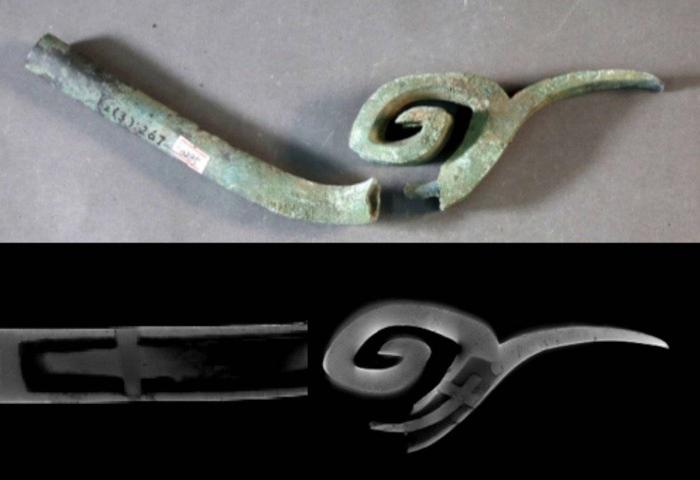 Combined technology of core rib and strip core support
The Sichuan Provincial Institute of Cultural Relics and Archaeology, in collaboration with the Palace Museum, used X-ray, CT and other scientific and technological means to discover core bones and strip-shaped core supports from the interior of the bronze. This is the earliest example of using core rib and strip core support technology in China.
Guo Jianbo told reporters that this technology is mainly found in bronze sacred tree trunks, bronze dragons, bronze small standing figures and other bronzes with a strong local style of “Sanxingdui”. The people who cast this batch of bronzes at that time used core bone and strip core support technology in order to meet the special needs of their shapes, such as long and thin branches. Core bone refers to adding organic matter or metal strips in the middle when making a mud core to strengthen and support the mud core, similar to the “steel bars” in modern architecture. The strip-shaped core brace runs transversely through the entire vessel including the surface, wall and clay core. Its function is the same as other core braces, fixing the position of the inner core. The core bones found in the Sanxingdui bronzes are made of organic matter and copper, and the strip core supports are made of copper.
Before the discovery of this technology in Sanxingdui, the domestic core bone and strip core support technology was first seen in the terracotta warriors and horses unearthed from the Mausoleum of Qin Shi Huang, and in the necks of bronze waterfowl. From a global perspective, it has also appeared in Italian and Greek bronzes from the 4th to 5th centuries BC.
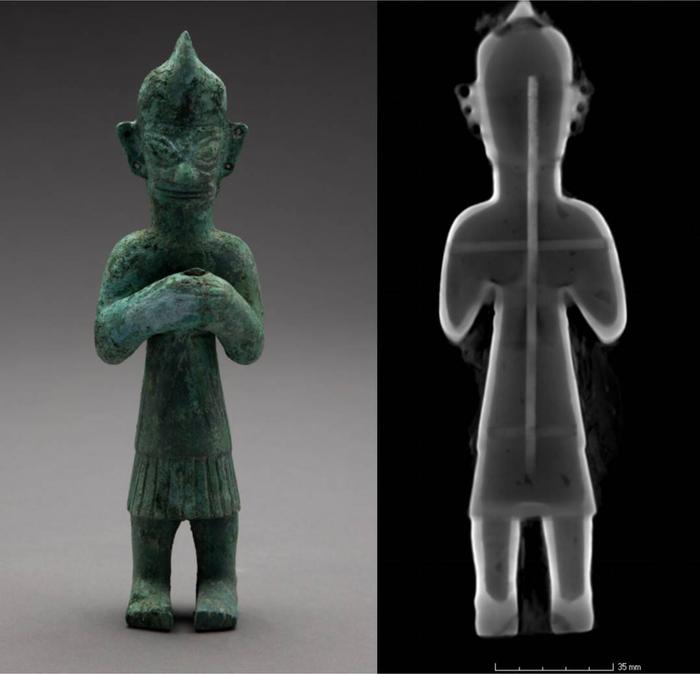 The core bone and strip-shaped core supports in the small bronze standing figure
It is precisely because of the unique shape of Sanxingdui artifacts that the mud core produced during the casting process cannot be removed. These preserved mud cores have become the key to deciphering the bronze casting site. The Sichuan Provincial Institute of Cultural Relics and Archaeology, in collaboration with the University of Science and Technology Beijing and the Institute of Geophysics, Chinese Academy of Sciences, provided reliable evidence for the casting site of the bronzes by analyzing the major elements, trace elements and rare earth elements present in the mud cores of the bronzes, as well as the deep soil of the Sanxingdui site. Scientific basis.
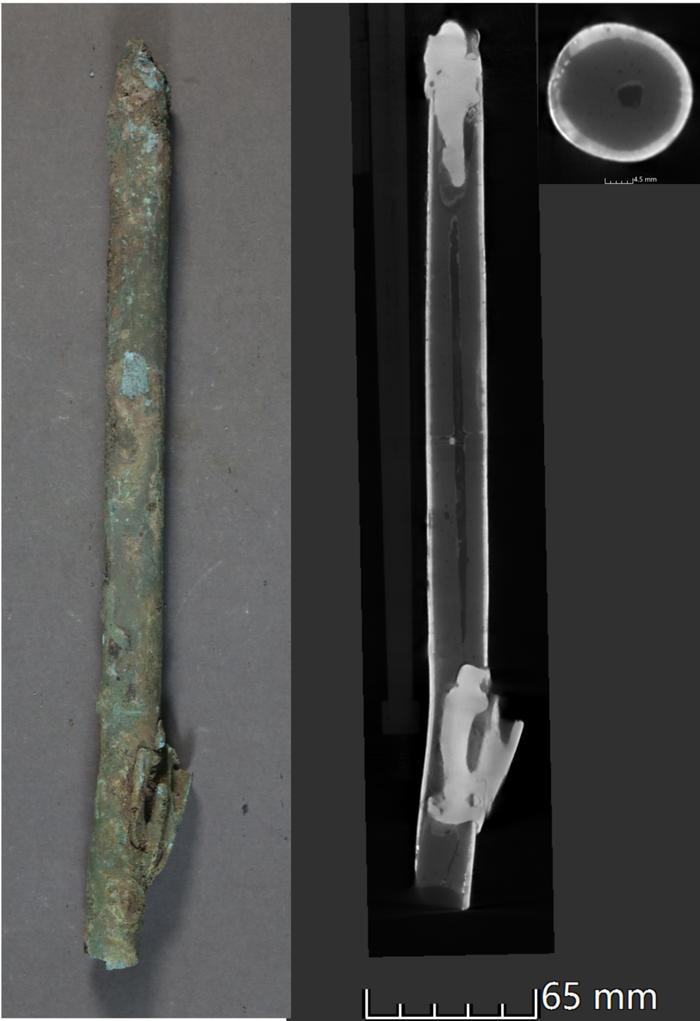 core bone in bronze
In the past, when scholars discussed Sanxingdui bronzes, they often divided them into two major categories in terms of shape. One type is bronze ware with the characteristics of the Central Plains civilization, such as bronze lei and bronze statues, and the other type is bronze ware with local style such as large bronze mask and bronze tall man. The results of this research may be able to confirm this view from experimental data.
Cleaning and restoration concepts evolve with the times
Form a full-process cleaning work model
As Sanxingdui archaeological excavation and research work proceeds, the concept of cultural relic cleaning and restoration is also advancing with the times. What is different from the past is that before cleaning, conservation personnel first need to conduct a microscopic observation of the surface to determine whether there are any residues of other organic substances. In 2021, researchers obtained silk samples through this method. The purpose of conducting proteomics analysis on soil samples is to determine the existence of animal sacrifice behavior during the sacrifice process and to obtain more information.
As early as January 1, 2023, the two cross-pit cultural relics, the bronze top statue and the bronze mythical beast, were put together for the first time through scientific and technological means. This possibility of “cross-pit matching” also has an impact on cleaning and repair methods. The damaged bronzes unearthed have not been repaired at present, because the incomplete fractures of the bronzes have become an important basis for judging whether they can be put together.
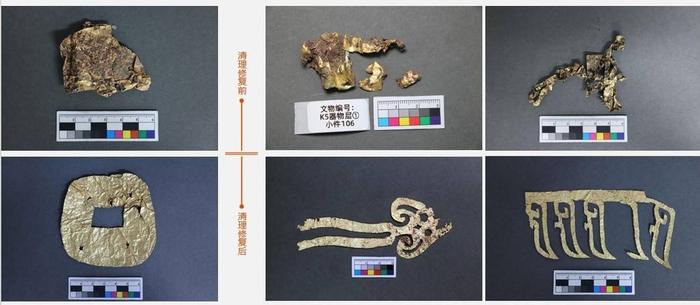 Sanxingdui cultural relics before and after cleaning and restoration
Previously, in an on-site interview at the restoration results exhibition, Yu Jian, deputy director of the Sanxingdui Museum, mentioned that many artifacts may have been artificially smashed when they were buried. The “one-step” restoration may cover up the clues left by the ancient Shu people.
Does this mean that the public cannot see the Sanxingdui cultural relics after they are fully restored or put together? This is not the case. For these incomplete parts, conservation personnel can already use digitization to restore them. Scanning, modeling, 3D printing, conservation and restoration workers and technicians work closely together to conduct research on the established models to show how the cultural relics will look after restoration, and to resolve differences in restoration views during actual operations.
Through the new round of cleaning of artifacts unearthed from the “sacrifice pit”, what is even more valuable is that cultural conservation personnel have explored a set of full-process cleaning work models, allowing the artifacts to be inspected through surface observation, information extraction, and soil sample retention. , current situation assessment, cleaning and other multiple steps to meet the standards for display.
This means that in future cleanup and restoration work, researchers will follow valuable experience and discover more clues from the artifacts unearthed in Sanxingdui.