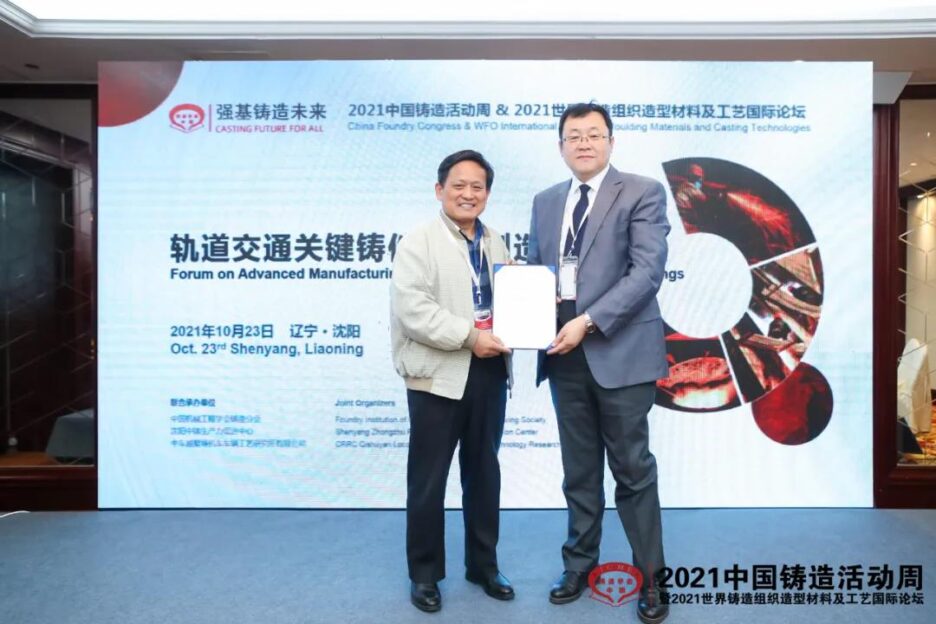
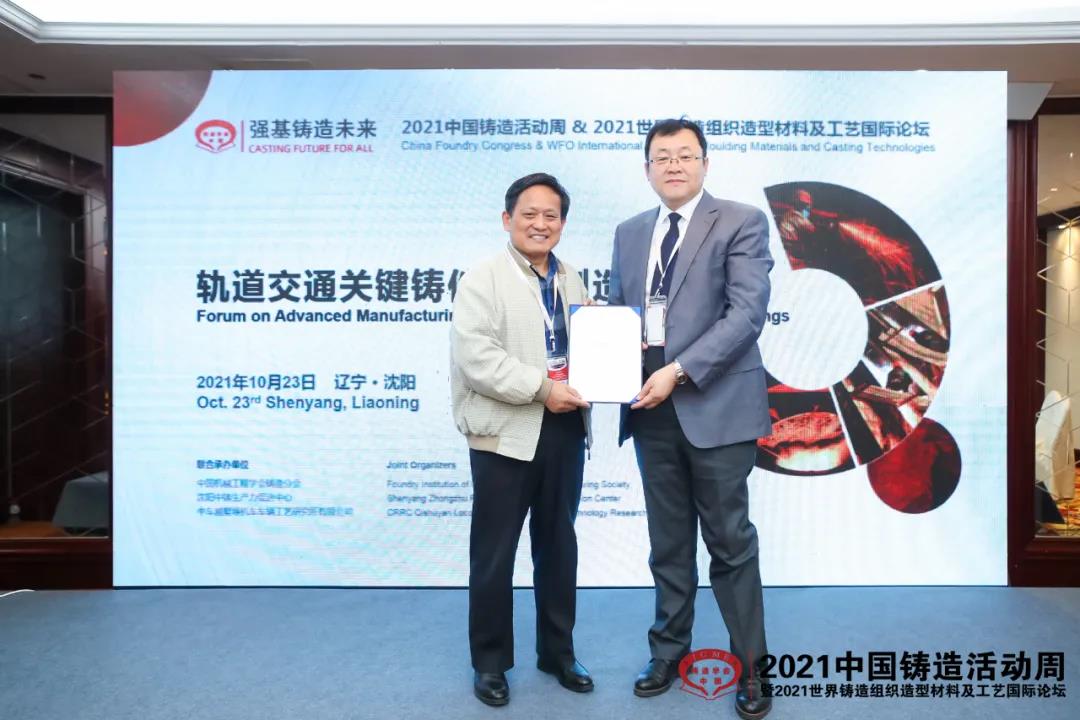
On October 23, the 2021 China Foundry Week’s Advanced Manufacturing Technology Forum for Key Rail Transit Castings was held at the Grand Metropark Hotel in Shenyang. Xu Guibao, senior engineer at CRRC Qishuyan Locomotive and Rolling Stock Technology The theme report of the 14th Five-Year Development Direction of the Transportation Foundry Industry. From the aspects of the development of the rail transit casting industry in the 13th Five-Year Plan, the existing problems in the industry, and the rail transit map of the National 14th Five-Year Plan, Mr. Xu analyzed and predicted the development direction of the rail transit casting field in the 14th Five-Year Plan.
He pointed out that during the 13th Five-Year Plan period, the national railway passenger volume and total railway freight volume continued to increase. The epidemic has suffered a greater impact on the development of the rail transit casting industry, but orders for subway vehicle castings have increased, and the overall purchase volume of the truck market has also increased. . The export market of transportation castings has recovered under the severe intensification of international trade frictions.
In this context, during the 13th Five-Year Plan period, China’s rail transit casting industry has achieved good results, including the basic stability of the railway casting industry, about 2 million tons per year; the steady improvement of key casting manufacturing capacity; the full realization of domestic high-end railway castings Basically all of them have replaced imported products; the lean quality management level of key enterprises has been significantly improved.
Although the railway foundry industry has made great progress, it also faces many problems, such as shortage of technical and skilled talents, insufficient corporate innovation capabilities, less investment in research and development, low-cost casting orders, difficulty in recruiting employees and unstable personnel, environmental protection Governance and safety production are relatively weak, and the development of automation and intelligence is slow. At the same time, there are key technical quality problems in the development of the industry, such as inertial cracks in heavy-duty couplers, small defects in high-speed cast steel brake discs and organizational uniformity; hot cracks on the surface of vermicular iron brake discs of passenger cars, and water glass sand collapsibility And regeneration will use the “bottleneck” problem.
He said that the “Fourteenth Five-Year Plan for National Economic and Social Development and the Outline of Long-Term Goals for 2035” pointed out the direction for the future development of China’s transportation field, and will also accelerate the construction of a strong transportation country. During the 14th Five-Year Plan period, the scale of China’s railways under construction and approved projects is 3.19 trillion yuan. It is estimated that by 2025, the national railway business history will reach about 170,000 kilometers, of which high-speed railways (including intercity railways) will be about 50,000 kilometers. The “National Comprehensive Three-dimensional Transportation Network Planning Outline” clearly pointed out that the total scale of the railway network will reach 200,000 kilometers by 2035, of which high-speed rail (including intercity railways) will reach 70,000 kilometers, and ordinary railways (including some urban railways) will reach 200,000 kilometers. 130,000 kilometers, the intercity railway network of urban agglomerations will accelerate development. The construction of urban agglomerations and metropolitan areas on the track is the focus of future construction. During the 14th Five-Year Plan period, 19 urban agglomerations will be developed and cultivated to form a “two horizontal and three vertical” urbanization strategy. The Beijing-Tianjin-Hebei and Yangtze River Delta 3. The three major urban agglomerations in the Guangdong-Hong Kong-Macao Greater Bay Area will build 3,500 kilometers of high-speed railways, bringing the total to 9,500 kilometers. It is planned to start construction of 10,000 kilometers of railways. During the 14th Five-Year Plan period, we will also vigorously promote the construction of smart and green rail transit. Faster, smarter, and greener are the development directions of high-speed rail.
Mr. Xu pointed out that as the quality requirements of rail transit castings become higher and higher, market competition is becoming more intense, and environmental and safety costs are also increasing, resulting in smaller and smaller profit margins for enterprises. Therefore, during the 14th Five-Year Plan period, the foundry must focus on the requirements of rail transit for key castings, strengthen quality awareness, implement lean management, insist on innovation-driven, implement a talent-first development strategy, and effectively combine the spirit of craftsmanship and innovation to enhance the overall casting production. The quality control ability of the process ensures the consistency of casting performance, quality stability and reliability of use, thereby improving the competitiveness of the company’s survival and development. Specialized and large-scale production is conducive to enterprises focusing on main production processes and main products, focusing on advanced production equipment, better organizing production factors, improving production efficiency, reducing overall operating costs, helping enterprises to achieve effective comprehensive management of environmental protection, and further improving the enterprise Core competitiveness.
During the 14th Five-Year Plan period, rail transit casting enterprises will transform and upgrade to digital, intelligent, green and lightweight. The factories should strengthen independent innovation, increase the research and development and application of new materials, new processes and new technologies, and use high-speed rail concepts and high-speed rail Spirit to build an advanced manufacturing platform, to achieve high-tech, high-quality and high-efficiency production, to achieve low energy consumption, low pollution and low emissions, and to take the road of sustainable development of green casting.