
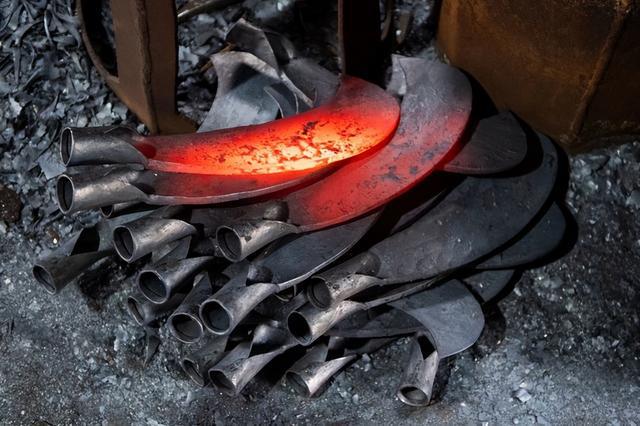
In China, a land full of historical accumulations, each region has its own customs and traditions, as well as its own traditional industries. However, it may not be difficult to retain customs and habits with the inheritance of culture, but traditional industries have experienced It is not easy to pass on after the times have changed.
1
Jiahe County, Hunan, known as the “Casting Capital of the South of the Yangtze River”, is such a rare place. The casting and forging of Jiahe County began in the Qin and Han Dynasties. According to records, during the “Qin Shu Wuling” period, Jiahe stockpiled grain and made equipment, leaving behind the smelting and casting skills of bronze weapons. The “Jiahe County Chronicle” records that the foundry industry rose in the late Ming and early Qing dynasties. During the Jiaqing period of the Qing Dynasty, Tiangangtou Village in Yuanjia Town partnered to cast iron pots for farm implements, etc. At the most brilliant time, Jiahe Blacksmith led a group of foundry craftsmen to go to Nanhua Temple to cast the “Thousand Monk Pot” at one time, and became famous for a while.
For a long time, Jiahe’s casting skills were not passed on. It was not until the late 1940s and early 1950s that it spread in the surrounding towns and villages. Yuanjia, Chengguan, Tangcun and other places began to operate the foundry industry, mainly producing ” “Three knives and two heads” (kitchen knives, sickles, contempt knives, hoes, shovels) and some other agricultural implements. After the reform and opening up, the first batch of technical talents in Jiahe County began to go to other places to establish enterprises, and the foundry industry of Jiahe gradually radiated to 32 counties and cities in Guangdong, Guangxi, Guizhou, Jiangxi and Hunan.
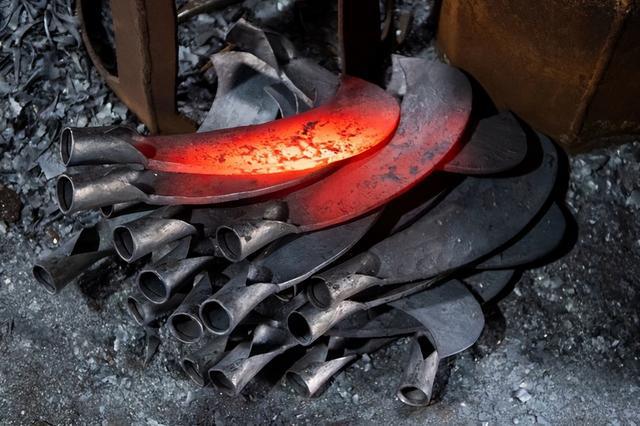
At the end of the 1980s, the casting and forging industry in Jiahe County had a greater development. The products changed from daily utensils to cast iron, cast copper and various mechanical parts and accessories. The developed hardware tools reached more than 2,000 kinds, 59 series, and the output reached 6,500. There are more than 10,000 pieces, including adjustable wrenches, pliers, gardening tools, set tools, telecommunication tools, agricultural tools and so on. Jiahe casting and forging industry began to enter its peak period. In the early stage of Shenzhen’s development, 90% of manhole covers came from Jiahe. The steel hoes produced in Jiahetang villages and towns once accounted for more than 70% of the national export share.
By the 1990s, Jiahe could be described as “fire in every village, and smoke in every household”. The villagers’ houses had shops and factories in front and kitchens in the back. At the same time, Jiahe, which was originally a small commodity distribution center in Hunan, has gradually declined with the development of the times. The once prosperous bull market and cloth market gradually declined, while the remaining hardware market has grown up, leaving room for development for Jiahe’s casting and forging. . At its peak, there were nearly 500 casting and forging enterprises in Jiahe County, with an annual output of nearly 800,000 tons of castings, ranking first in Hunan Province. Jiahe has been awarded the titles of “Jiangnan Casting Capital” and “China Forging Town” by China Foundry Association and China Forging (Press) Association.
2
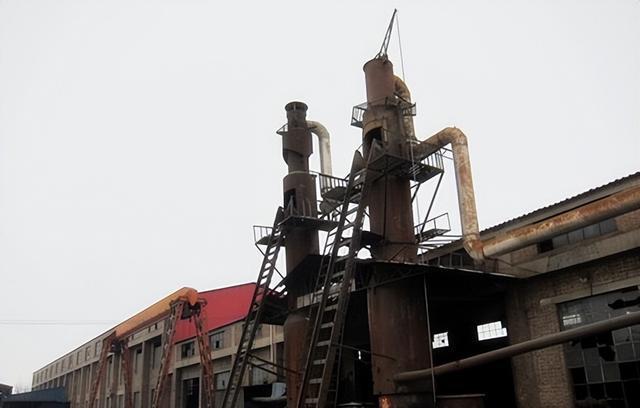
Behind this somewhat barbaric rapid development, various problems are increasingly exposed. The first is the high energy consumption and high pollution. At that time, almost everyone who had been to Jiahe could feel it. For example, on the only way from Yuanjia Town to Tangcun Town, the 2-kilometer long roadside was full of people. It is a foundry workshop, the road is blackened with cinders, and the abandoned castings are also piled up on the roadside. At that time, Jiahe’s casting and forging enterprises were vividly summarized as “black, big and rough”, and all small enterprises were also included in the county’s “blacklist” for energy conservation and emission reduction.
Another major problem is that Jiahe’s casting and forging enterprises are generally managed by family. Many business owners have not received good cultural education. They are inevitably limited by the economic awareness of small farmers in their operations, and it is difficult to form large-scale production and effective matching.
Of course, what affects the development of Jiahe casting and forging industry the most is the lack of product competitiveness and low profits. In the 1990s, in order to seize the market, many companies of Golden Harvest chose to “buy brand” production in Hubei, Shanghai, Jiangsu, Yunnan and other regions. They did not establish their own brands, and they needed to spend a high amount of trademark and brand fees every year. Seriously restrict the development of enterprises.
Under such a development model, Jiahe’s foundry enterprises are becoming more and more competitive, and their profit margins are getting smaller and smaller. In 2006, in a report in “China Economic Weekly”, a company specializing in the production of steel hoes revealed that their annual output value exceeded 10 million but there was almost no profit at all. The material price per kilogram is only 4.93 yuan, and the price of such a steel hoe is 5 yuan in the market, and the gross profit is only 7 cents. In this way, there are still peers fighting the price war and selling it to 4.9 Yuan.
Another foundry with an annual output value of nearly 30 million yuan, due to the low profit, only pays more than 800,000 yuan in taxes a year, and a casting generally only has a gross profit of 3%-5%, and some even less. Because most of the foundry companies have low technological content and low market threshold, once the profit of a certain product rises, local companies or other domestic companies will flock to the market, and the market will quickly fall into a situation of oversupply, and the profit margin will be compressed to almost no . This “dilemma” of disorderly competition was also a major crux of Jiahe’s casting and forging industry.
3
The Golden Harvest foundry industry is faced with the problems of high production energy consumption, heavy pollution, and does not meet the national environmental protection standards; there are many family-based production workshops; the industrial chain is incomplete, the high-end level is not enough, and the added value of products is not high. To develop traditional industries, if they continue to develop in accordance with the traditional model, there will be no vitality, and transformation is imminent.
The leadership of Jiahe County realized as early as more than ten years ago that although the transformation of the casting and forging industry is difficult, it has a long-term development prospect. Jiahe County was once one of the 100 key coal mining counties in the country. The coal industry is the largest source of local financial revenue, followed by the foundry industry and flue-cured tobacco industry. As a non-renewable resource, coal has little growth potential. Flue-cured tobacco is likely to decline in the future. Only the casting and forging industry has potential for development.
Once the direction is determined, it is necessary to start taking action. It is clear that the foundry industry is the first industry. Jiahe County has formulated the “Three-Year Action Plan for the Transformation and Upgrading of the Foundry Industry (2019-2021)” and “Several Opinions on Accelerating the High-quality Development of the Foundry Industry” and other documents, a 60 million yuan industry introduction fund has also been established to provide strong support in administrative approval, land use, financing, and talents.
For example, in terms of talents, Jiahe County Vocational Secondary School actively responded to the needs of the foundry industry, trained a group of “foundry craftsmen” urgently needed for industrial development, and provided professional talent support for the development of the foundry industry. In the past 8 years, it has transported 1,273 foundry craftsmen and trained more than 4,600 on-the-job foundry workers. Of course, in the current environment of labor shortages in the manufacturing industry, there is still a large gap in talent demand to be filled.
The next step is to focus on environmental protection and eliminate backward production capacity. In 2017, after the first round of the central environmental protection inspection team was stationed in Hunan, the environmental problems of the casting and forging industry in Jiahe County were prominent, and 80% of the enterprises were ordered to stop production for rectification. Subsequently, Jiahe County made a comprehensive deployment to eliminate backward production capacity and promote the transformation and upgrading of the casting and forging industry. It has successively stopped production of 76 disputed casting and forging enterprises, banned and closed more than 50 backward enterprises, and demolished more than 250 “cupolas”.
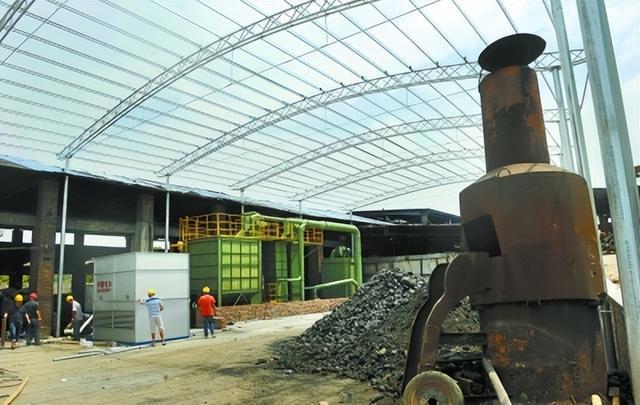
While dismantling old coal-fired boilers, the company actively promoted coal-to-electricity conversion. The company replaced it with an intermediate frequency furnace that uses electricity. The operation is simple and the temperature control is accurate. One person can manage it. Compared with coal furnace operation, the qualified rate of products is higher. The environment has said goodbye to smoky fire, and yields and profits have increased. A year later, according to the statistics of Jiahe County, although the number of local casting and forging enterprises has decreased significantly, the total output value of the casting and forging industry is still 16.302 billion yuan, a year-on-year increase of 10.91%.
The most important thing is to improve the competitiveness of the industrial chain. In order to guide business owners to take corporate operation, Golden Harvest has intensified the construction of characteristic industrial parks and built the only characteristic foundry industrial park in Hunan Province. At the same time, the industrial chain is promoted from the middle and upper reaches to the downstream, and the production of castings is changed into machinery manufacturing, forming a pattern of “one area and two areas”, that is, the Tantang area to which Tantang Industrial Park belongs is positioned to develop the machinery and equipment manufacturing industry, and the Xinglang area Positioned to develop intelligent casting industry.
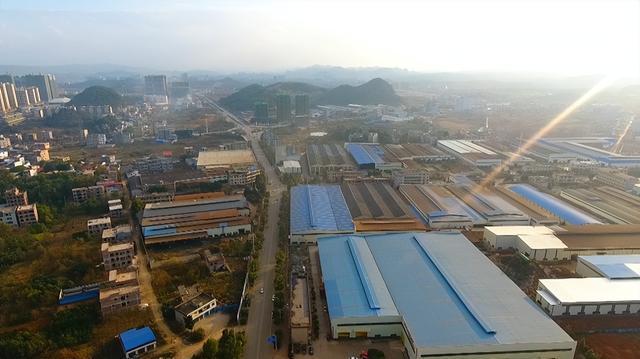
In recent years, Jiahe County has strengthened cooperation with Hunan University, Central South University, China Foundry Association and other relevant units and institutions, and has arranged industry guidance funds every year to encourage enterprises to use new technologies and new processes, increase investment in independent scientific research, and take the road of scientific and technological innovation. Jiahe County has also introduced “Industrial Internet + Blockchain” to guide the digital transformation of enterprises in the park, focusing on cost reduction, energy saving and consumption reduction, and further improving the functions of platform procurement, orders, regional promotion, etc., to help Jiahe Casting and Forging Industry Cluster with high quality develop.
4
Now, Jiahe’s casting and forging industry has been reborn, from “low-end” to “high-end”. Some companies are producing door hinge parts for Tesla and shock absorber parts for Mercedes-Benz. Its products have successfully entered the market. International market, exported to Germany, the United States, Japan. Golden Harvest has also started the road of industrial cooperation with well-known enterprises such as Sany Heavy Industry, Railway Construction Heavy Industry, and Zoomlion.
Forging and casting products have developed from single agricultural tools and knives to the entire hardware tools and emerging technology products, with 68 self-created brands, with China’s well-known trademark “Xiangjiang”, Hunan Province’s famous “Knife King”, “Shun Shun” and “Lao Niu King” Brands such as “Jiangxia Qulong” have achieved a gorgeous turn from OEM production to self-created brands.
From “Jiangnan Foundry Capital”, “China’s Hometown of Forging” to “Precision Casting Town”, to “National Foundry Industry Cluster Pilot Counties” and “Hunan Foundry Industry Base”, Jiahe County has passed thousands of years of inheritance and development. What has changed is the word casting, and what is constantly changing is the change in concepts behind industrial development, enterprise transformation, and technological upgrading. This kind of traditional industry, which is stable and unchanged in the changing tide of the times, is full of the taste of Chinese-style industrial heritage.
Source: Xinhua News Agency, People’s Daily, Red Net, Huasheng Online, Hunan Daily, Jiahe Release, China Electronics News, China Economic Weekly, Dajing.com