
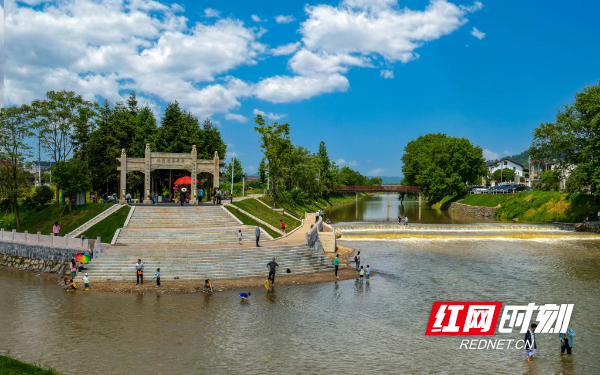
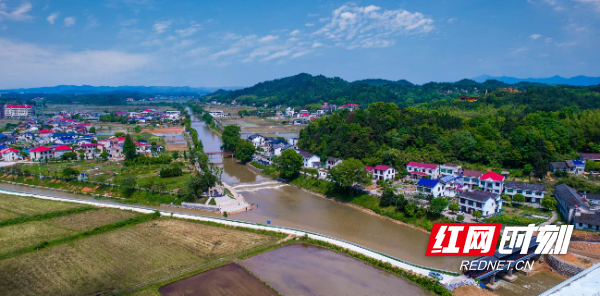
 The Shuimei Village in Jinjing Town drives local eco-tourism.
Red Net Moment News Correspondent Peng Huang reported from ChangshaAsphalt road with white walls and black tiles, greenery in front and back of the house, clear water ponds and blue waves… Walking into Jinjing Town, a small tea town in Changsha County, Hunan Province, as far as you can see are spacious and flat village roads, scattered houses, water Mantianchou, Lin Cui and vegetables are abundant, just like a beautiful rural picture scroll of “people in the scenery, scenery reflects the waves”.“Pedestrian trails are both water-friendly and green. Everyone loves to take a walk here after dinner and tea.” Aunt Liu, who lives by the Jinjing River in Jinjing Community, sighed sincerely. The newly built walking trails, wind and rain corridors, streams and water walks form a scenic belt along the river. Residents sit on wooden benches to rest, or walk together, or exercise their muscles and bones on the hydrophilic platform, which is a pleasant and comfortable scene.In recent years, Changsha County has further innovated and practiced in terms of river and lake governance concepts, paths and methods. The county’s 50 rivers, 132 reservoirs, 1 lake, and more than 58,000 small and micro water bodies such as ponds and ditches are all included in the river and lake long-term. system management, to achieve full coverage of management and protection, and greatly improve the water ecological environment.“Now the water in the village is clear, and there are fish, all of which are big.” In Putang Village, Jinjing Town, Yang Mang, the village party secretary, pointed to the clear water surface in the village after the remediation of small and micro water bodies, and remembered that when he was a child, “touching the water” Fish and shrimp time”.Like Yang Mang, there are many people in Changsha County who have awakened their childhood memories from the tangible results of flood control.Luo Ziyang, a cadre in Shijing Village, Jinjing Town, said that the creek in the village turned out to be crystal clear. However, as the days became more prosperous and the family became rich, the river in front of the door became smelly. “At the worst, you can smell it when you pass by the water.” Luo Ziyang shook his head as he spoke of the situation at that time.“In the past, sewage from bathing and laundry, and manure from duck sheds and chicken pens were directly discharged into rivers and ditches.” Zeng Lixiang, director of Jinjing Town Agriculture and Rural Affairs Office, introduced that the pollution of small and micro water bodies not only affects domestic water and farmland irrigation, but also affects Village appearance and public health.“These small and micro water bodies look small, but they are multi-faceted and difficult to control.” Zeng Lixiang said frankly that in the past, sewage collection and treatment facilities were lacking, planting and breeding were scattered, and non-point source pollution was relatively serious. plate.In order to control small and micro water bodies, Changsha County made an iron fist attack. The county river chief’s office issued the “Changsha County Small and Micro Water Body Management and Protection Implementation Plan”, which clarified the management and protection goals and main tasks, and included the daily management, protection and remediation tasks of small and micro water bodies into the important content of the target assessment of the river chief system. The county water conservancy, agricultural and rural, finance, and ecological environment departments perform their respective duties and work together to dedicate to the management, protection and improvement of small and micro water bodies.Find the “roots” on the shore from the “problems in the water”. Changsha County blocked the pollution discharge outlet, and fully managed the domestic sewage, and then made “articles in the water”. Luo Ziyang said,By controlling the source and intercepting pollution, the water bank is linked, and the small river in front of the door has returned to the past. “Living by the clear water is the taste of a happy life.” Zeng Lixiang said of the love of the country in the clear water.In recent years, Changsha County has focused on water control, water protection, and water enhancement, and coordinated the promotion of water, landscape, and income enhancement, so that clean and beautiful water becomes the best carrier of aesthetic economy, and the ecological lines of rivers and lakes become Changsha. County’s “Get Rich Line”.“The May 1st holiday is full every day, and there are repeat customers from Guangzhou and Shenzhen.” Speaking of his own business, Zhang Yong from Jinlong Village, Jinjing Town smiled happily, “Many guests come in groups from the city, just to see our good mountain, Good water, good scenery.”In recent years, Jinlong Village has dredged dozens of large and small rivers, lakes and ponds, including Jinjing River, and renovated the embankments, greening and beautifying.The clear river water not only beautifies the countryside, but also paved a road to prosperity. On the banks of the Jintuo River in Xiangfeng Village, Jinjing Town, hundreds of acres of ponds are full of lotus flowers, swaying and competing in summer, attracting countless tourists to check in. Dai Zhiyong, a villager of the Wanli Housing Group, greeted warmly. This harvest season is his favorite.Dai Zhiyong said: “Because the environment in the village is good, there are beautiful scenery all year round. The five major industries in the village, namely Xiangfeng Tea Garden, Sanzhen Tiger Garden, Ecological Garden, Kiwi Fruit Orchard and Farm Vegetable Garden, have driven rural tourism. The original ecological farmhouse, tourists like the fresh natural environment here, this season, watching tigers, appreciating lotus, picking fruits, eating lotus roots, it is very comfortable. Watching the beautiful scenery at the door of the house and doing the work, you can have a good time without leaving your family. The income and the happiness index will naturally be higher.”There are many such farmhouses in Changsha County. With the advantages of the environment, many villagers get rich on both sides of the river, leaning on the mountains and rivers.The good water ecological environment has also driven the social and economic development of Changsha County. The Songya Lake National Wetland Park, with a lake area of nearly 10,000 mu, has driven the development of the surrounding urban areas; the ecological leisure agriculture radiated by the scattered reservoirs in the territory is booming. With less pollution and more scenery, the river has become a carrier for inheriting and highlighting the characteristic culture of the township region, improving the quality and value of the regional environment space, increasing the attractiveness of the region, and becoming a “fairway” for villagers on both sides of the strait to get rich.In the Shibi Lake Ecological Park in Jinjing Town, there are a few leisurely anglers sitting quietly. Yang Zhujun, a villager in Jinlong Village, National Civilization Village, who lives near the park, moved to Chaxiangxinyuan Community not far from the park in 2014, and witnessed the growth of Shibihu Park from its construction in 2014 to its completion in 2016.He said: “After the completion of Shibi Lake Park, the nearby villagers and I have another good place for leisure. There are many people walking, cycling and dancing in the square at night. When you are lucky during the day, you can catch a lot of fish. It’s a pound of fish.” Big Brother Yang said, shaking his lucrative fishing bag with satisfaction.In the 20th century, the locals built Shibi Lake, but due to various reasons, the lake surface silted up, the lake shrunken, and a large area of wetlands could not be used. The surrounding farmland was vulnerable to flood disasters. The construction of Shibi Lake Park has turned waste into treasure, integrating viewing, irrigation, flood control, drought resistance, water cleaning and other functions.Zhang Li, deputy secretary of the Jinjing Town Party Committee and mayor of the town, introduced that the plants with the ability to purify water such as foxtail algae, calamus, windmill grass, and canna planted in wetlands can effectively reduce water eutrophication, ammonia, nitrogen and other indicators. The upstream sewage from the wetland inlet is further filtered and purified in contact with wetland plants and soil, and finally discharged from the outlet to the river for production irrigation. And people can also freely shuttle in the greenway of the wetlands and get in touch with nature at zero distance.Various constructions based on water are also quietly emerging in tea towns. The theme park of “Clean Tea and Clean Rhyme” has become a well-known check-in point of “integrity and clean government” in the suburbs of Changsha; along the Jinjing River, a demonstration film of the city-level beautiful Happy River and the beautiful and livable villages of Jingxi has been built; The ancient tea transport wharf and Jinlongba have not only built a beautiful village, but also promoted the development of the local leisure tourism industry.As Liu Zhiping, Secretary of the Party Committee of Jinjing Town, said, building a demonstration area for common prosperity requires both shaping and soul-building. Jinjing Town digs deeply into the local cultural characteristics, creates a model of cultural and tourism integration with local characteristics, and gives new era connotations to rejuvenate traditional culture, further unite people’s hearts, educate the masses, and chunhua folk customs, and mobilize the masses to join the rural revitalization project. Career positivity and initiative. At the same time, it will accurately meet the market consumption demand, combine agricultural production, agricultural product processing with modern characteristic agricultural industry, expand and extend the industrial chain, spawn more new industries and new formats in the countryside, attract tourists from all over the world, and appreciate the “country style, country, local customs, Nostalgia”, feel “nostalgia, nostalgia, nostalgia, nostalgia”, and better transform cultural advantages into economic and social benefits.At present, the towns and streets of Changsha County are based on the management and protection of rivers and lakes, develop green ecological industries according to local conditions, build an industrial chain of rivers and lakes, and achieve “relying on rivers to eat rivers and water for water”, creating “green water and green mountains are Jinshan Yinshan” practice innovation base is helping to forge the “golden key” for villagers to achieve “a rich life”.The green waters meander away, and the green mountains open towards each other. A picturesque and common prosperity of the rural revitalization green road is unfolding in Changsha County.