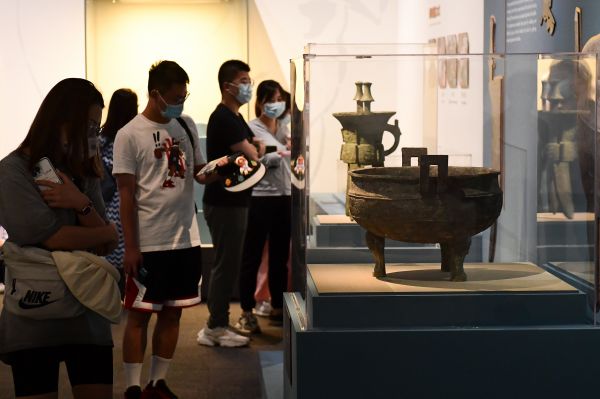
Reference News Network reported on August 12 According to the British “New Scientist” weekly website reported on August 10, the missing ingredients in ancient Chinese bronze recipes may have been found, which revealed another level of advanced chemical operations at that time.
The 2,300-year-old “Kaogongji” is the oldest technical encyclopedia in the world, the report said. The book contains instructions on how to make several objects such as metal drums, chariots and weapons, as well as 6 bronze recipes that have long puzzled researchers.
While bronze casting was not unique to China at the time, Liu Ruiliang of the British Museum in London said the style and scale of Chinese bronze making was unrivaled.
Bronze is usually smelted from a mixture of copper and tin. At the heart of the recipe mystery is that researchers have been unable to identify the two components “gold” and “tin.” In modern Chinese, gold means gold. In ancient times, however, “gold” was thought to refer to copper or copper alloys. Meanwhile, “tin” has always meant tin.
But chemical analysis of bronze vessels from that period showed that “gold” and “tin” could not be as simple as copper and tin.
Liu Ruiliang and colleagues analyzed previously compiled data on the chemical composition of knife coins that were minted in the same age as the bronze recipes were recorded. After they figured out the relationship between the various metals contained in the knife coins, they believed that the knife coins were smelted from prefabricated alloys.
They found that the higher the lead content in knife coins, the lower the copper and tin content. The knife coins with the highest copper content also have the highest tin content. These findings suggest that lead was mixed into an alloy of copper and tin — a bronze alloy.
After modeling the different combinations, the team determined that the 80:15:5 copper-tin-lead alloy mixed with the 50:50 copper-lead alloy in different ratios best matched the chemical data for the coins.
Liu Ruiliang said that these prefabricated alloys are likely to be the “gold” and “tin” mentioned in “Kao Gong Ji”. But he added that the recipes in the book may not reflect how bronzes are usually cast.
“The recipes may be too specific,” he said. “The people who actually do the work may not be able to read and write, and they can’t write down the recipes. I think there’s a knowledge gap between the people who write the recipes and the people who actually do the work.”
Jianjun Mei of Cambridge University does not fully agree with the findings. The recipes should not be considered an accurate record of the smelting methods of the time, he said. “These record-keeping officials may only focus on the most important materials, like copper and tin, and not so much on other materials,” he said, adding that if you take “gold” and “tin” in the text as copper and tin, then these recipes still work for the most part.