
“Don't you see that Kunwu's iron smelting is flying in flames and smoke, and the red light and purple gas are impressive. After several years of hard work, the sword was named Longquan.” Guo Zhen of the Tang Dynasty wrote a poem in “The Sword Chapter”, praising the shape and character of the Longquan sword. , it is not difficult for people to imagine the repeated tempering, toughness and sharpness of the Longquan sword.
The Longquan Sword, which dates back to the Spring and Autumn Period and the Warring States Period, has been passed down for more than 2,500 years. In the long-term development, Longquan sword has formed four traditional characteristics in terms of product quality: toughness and sharpness, hardness and softness, cold light, and ingenious decoration. The craftsman's fire never goes out, and the hammer hammers endlessly. Across the long river of history, Zou Qi, a “post-95” girl from Longquan, Zhejiang, is currently banging hard amidst the sound of “ding-dong”.
Zou Qi was born in the “Sword Family” and is the fourth generation inheritor of the Zou family's sword-making skills. Since ancient times, swordmaking has been a male-dominated industry. Therefore, many people think that “female swordsmith” is a gimmick and a show. Zou Qi wants to prove that “I am serious about being a swordsmith.” She learned patterns, learned forging, was able to swing a hammer, and had the patience to carve exquisitely. She took it as her mission to “sword culture is everlasting and sword-making skills are passed down from generation to generation.”
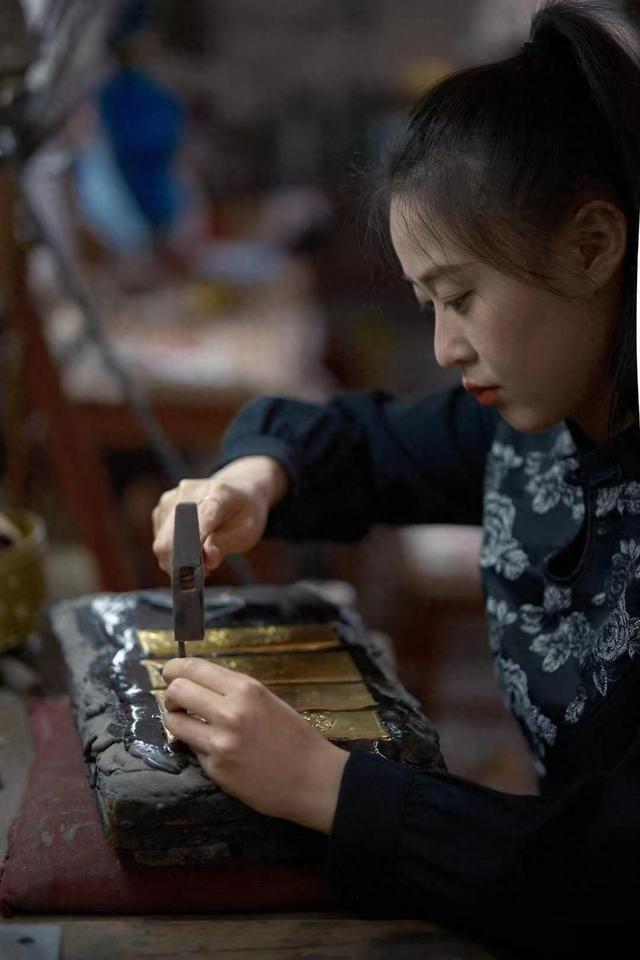
Zou Qi at work
The fourth generation inheritor of sword-making skills
Zou Qi grew up in a sword workshop, and everyone for three generations was familiar with swords. Recalling her childhood life, the sound of “ding, dong, dong, dong, dong, dong, dong, dong, dong, dong, dong, dong, dong, dong, dong, dong, dong, dong, etc. of forging iron still seemed to be lingering in her ears. She remembered the smell of rust and coal, the steaming heat next to the stove, and the big beads of sweat on her father's face as he worked.
Zou Qi was born in a “sword family”. Her grandfather Zou Zhizhang was familiar with sword-making skills and created the three-dimensional embossed technology of Longquan sword which is still used today. His father, Zou Jianming, took over the family tradition from his grandfather and has been in charge of the sword workshop for more than 40 years. Zou Jianming is committed to the integration and innovation of ancient carving and Longquan sword forging techniques. He is good at traditional techniques such as manual copper-clad embossed engraving and ancient blow welding. He has been recognized as an intangible cultural heritage of Zhejiang Province (Longquan sword forging techniques). Representative inheritor.
As the proverb goes: “There are three hardships in life: blacksmithing, punting, and grinding tofu.” Zou Jianming, who has been in the sword industry for many years, knows that swordmaking is hard work. He feels sorry for his daughter and is reluctant to let her work in this industry. Like ordinary children, Zou Qi studied and passed the exams. After graduation, he found a nine-to-five job and stayed away from the “daggers and swords”.
Until 2020, when the live broadcast industry was booming, at the request of his father, Zou Qi went home to help with live broadcasts, introducing sword culture, history, production techniques, etc., hoping to increase sales for the family's swords. At first, Zou Qi worked during the day and broadcast live at night. Because she was not familiar with the sword-related knowledge, she had to bite the bullet every time the broadcast started. “I still remember that during the first live broadcast, my face was red with nervousness and I couldn't speak smoothly.”
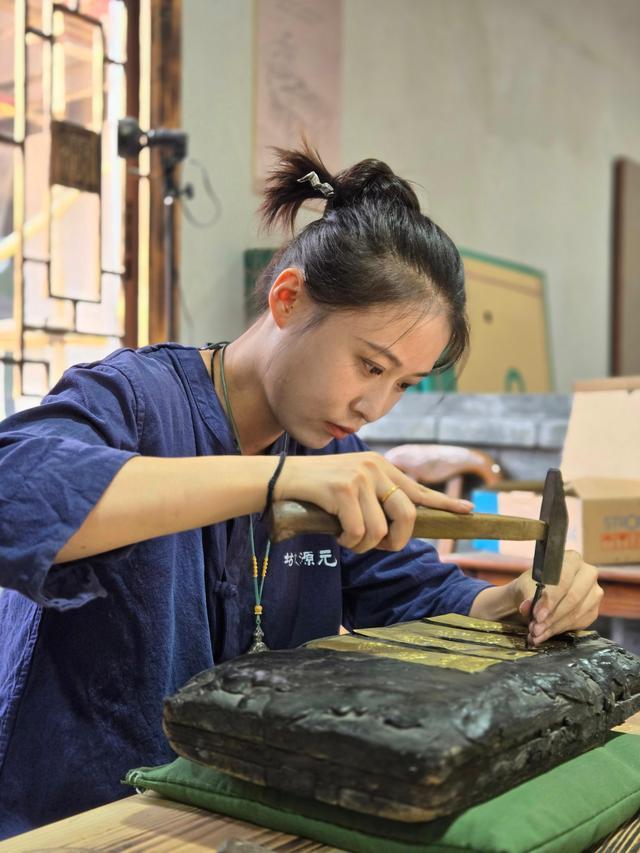
Zou Qi at work
Zou Qi has had a strong personality since she was a child. She began to read widely about sword-related books to understand the unique craftsmanship of her own sword workshop. Deeply impressed by the rich cultural heritage of Longquan sword, Zou Qi gradually fell in love with the sword-making business. Four months later, Zou Qi quit his job and devoted himself to the sword industry.
“On the one hand, it is out of love, and on the other hand, it is responsibility.” The more he realizes the beauty of sword culture, the more Zou Qi feels the weight of the burden on him. “We only have two daughters in our family. As the eldest daughter, I have the responsibility to pass on the sword-making skills. The craftsmanship passed down by our ancestors for so many years cannot be discontinued in my generation.”
The most important thing when making a sword is persistence
“The edge of a sword comes from sharpening, and the fragrance of plum blossoms comes from the bitter cold.” After entering the industry and starting to learn skills, Zou Qi finally understood the true meaning of this poem: an exquisite sword is made from the hard work of the swordsmith.
Zou Qi introduced that from raw materials to a finished sword, there are hundreds of processes, large and small. The industry is currently simplified and summarized into 28 processes, including smelting, forging, shoveling, filing, engraving, copper inlay, cold forging, and quenching. , polishing, etc.
On the way to becoming a swordsmith, Zou Qi believes that there are not many real difficulties, and the key lies in the word “persistence”. “Blacksmithing seems to be a very simple job. Anyone can swing a hammer once, but what if you keep swinging it hundreds or thousands of times over many years? How many people can persevere?” Zou Qi said, beating a handful of steel bars. Making a sword is a boring and difficult process, and so is the growth path of a swordsmith.
In the sword-making industry, “forging iron” is also called “catching the fire”, which means that you need to rush to shape the sword while the iron bar is red-hot and softened. You can't stop after the first hammer falls until you are done. This process often lasts for several hours and is extremely physically demanding. Female swordsmiths are inherently inferior in physical strength, so Zou Qi had to grit his teeth and persevere. Often, his arms would be sore, numb, and swollen.
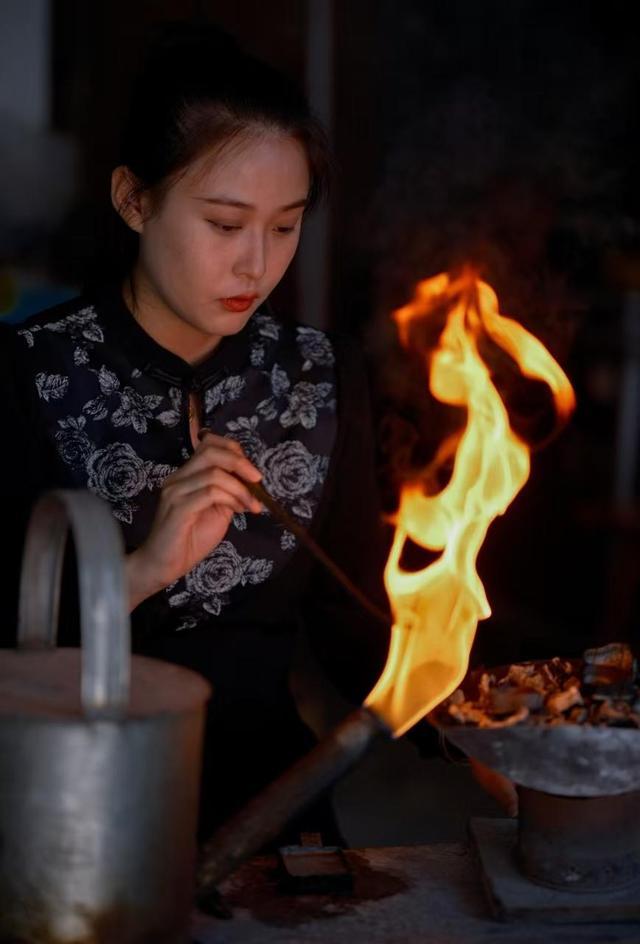
Zou Qi at work
“Everything comes from practice. The more you swing hammers, the strength of your arms will really increase.” Now, Zou Qi can swing a hammer weighing more than 5 kilograms with one hand. She laughs at herself that she has developed “Qilin arms”.
In addition to the hard work, there are also scars. Sparks splashing on one's body when forging iron, or cuts on one's hand while sharpening a sword's edge have become commonplace. Zou Qi didn't take these minor injuries to heart, “It's normal for people who do crafts to get injured.” What made her a little sad was that after learning the craft, she wore a pair of coarse blue work clothes all day long, along with manicures and contact lenses. Nothing to do with makeup. Zou Qi said with a smile: “There is no girl who doesn't love beauty, but if you want to learn skills well, you will inevitably have to give up something.”
Let the sword enter the public eye
Since ancient times, swordmaking has been a male-dominated industry. Although Zou Qi came from a sword-making family, he still couldn't escape criticism and gossip from others. Many people blurt out the word “show” as soon as they see the title of “female swordsmith”. Zou Qi is neither angry nor angry about this, “Hua Mulan is still joining the army for her father. I just need to work hard in my own direction.”
Zou Qi said that there are several highly skilled female swordsmiths in Longquan. Of course, women are inferior to men in terms of strength, but in terms of sword decoration skills, women are more delicate and gentle than men. The Longquan sword's “exquisite decoration” is famous throughout the ages, and female swordsmiths have their own unique talents.
“Men pursue calmness when making swords, and the colors are mostly silver and gray, but I prefer bold colors such as bright red and green. The decorations are also eclectic and mostly incorporate martial arts elements,” Zou Qi said.
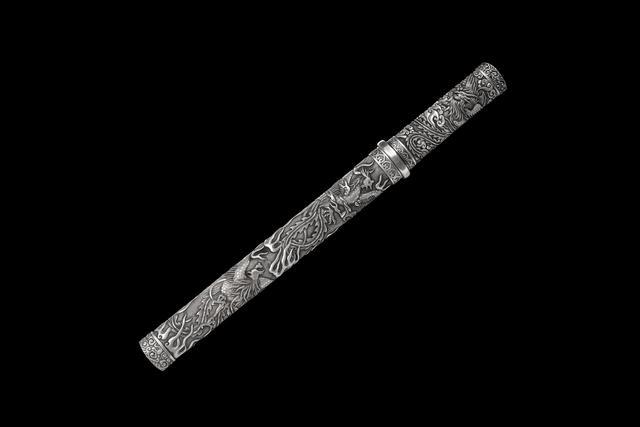
The “Phoenix Nirvana” sword designed by Zou Qi
Now, with the help of his father, Zou Qi has successfully forged four or five swords. Her most unforgettable thing is the first sword “Phoenix Nirvana”. “Most men love dragon patterns. The phoenix is the female perspective that I specially brought in, and the phoenix nirvana corresponds to my state of mind at that time when I resigned from my comfort zone and entered the sword industry.”
In order to obtain design inspiration, Zou Qi read ancient books and visited museums everywhere, extracting the essence from ancient totems and patterns and integrating them into the production of swords. For example, Zou Qi was inspired by the style of Yang Guifei's sachet and designed a Tang Dao.
In addition to traditional sword-making techniques, in order to attract the attention of more young people, Zou Qi spent her time thinking about a series of sword cultural and creative products. Based on the “Yunlong Sword”, she designed a cute “Q version of the sword”, which can be used through necklaces, Various products such as refrigerator magnets and keychains attract young customers. Zou Qi said that in the past, the customer base of swords was mostly middle-aged people in their forties and fifties, but in recent years, the number of young people who love swords has continued to increase. For example, the “Phoenix Nirvana” designed by Zou Qi was bought by a female high school student. Walk.
Today, when cold weapons are increasingly losing their practicality, the inheritance of sword-making skills lies more in the inheritance and development of sword culture. Zou Qi hopes that the sword will not only exist in museums or collection shelves, but can truly enter the public's field of vision, so that more people can appreciate the beauty of the sword.
Sword-making is an unpopular and hard-working industry, and learning the art is a very long process, so few young people join it today. Zou Qi wants to use his own example to inspire more young people to see and love swords, and to rejuvenate the sword culture.
“Yangcheng Evening News” version 20241102A5
Text丨Reporter Wang Junjie Picture丨provided by interviewee