
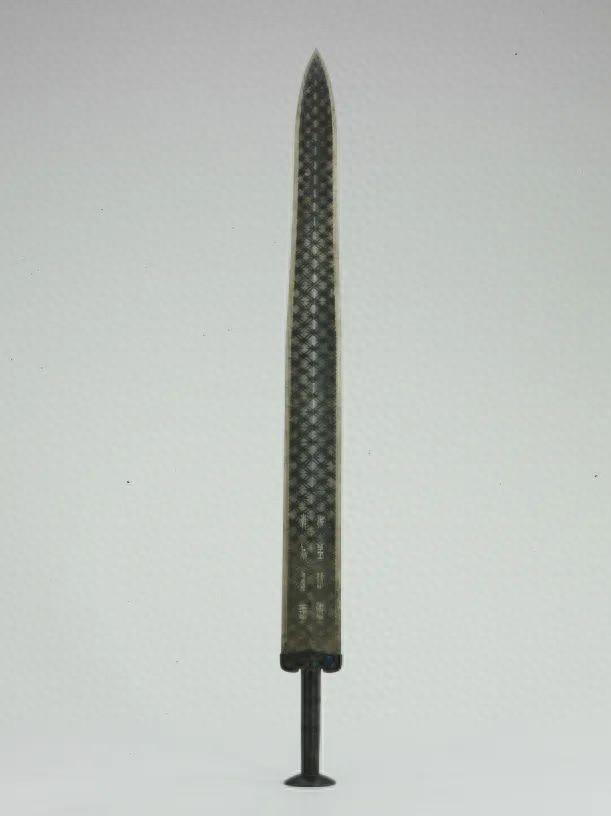
Today (April 29), at the event commemorating the 60th anniversary of the discovery of King Goujian of Yue, Jiang Xudong, director of the Cultural Relics Protection Center of Hubei Provincial Museum, released the latest research results of King Goujian of Yue. Experts speculate thatThere are 7 steps to make the sword of King Goujian of Yue. Research also shows that the sword body of King Goujian of Yue contains about 18%-20% tin.
The King of Yue Goujian Sword was unearthed in Tomb No. 1, Wangshan, Jiangling, Hubei in 1965. This tomb is a typical Chu tomb, with rich and exquisite burial objects. According to the shape of the tomb, the burial objects and the unearthed bamboo slips, it can be seen that the tomb owner is Daogu. He is a descendant of King Dao of Chu and mainly lived around King Wei of Chu in the middle of the Warring States Period.
The burial objects of the No. 1 Tomb of Wangshan are well preserved and have a rich variety of objects, with a total of 783 pieces. According to their purpose, they can be divided into daily necessities, musical instruments, weapons, chariots and horses, clothing, document tools and bamboo slips. It is mainly placed in the head box and the side box, and a few are placed in the coffin. The sword of King Goujian of Yue was unearthed from the inner coffin.
The King of Yue Goujian sword is 55.6 cm long, 4.6 cm wide, and weighs 875 grams. After the sword was unearthed, the owner of the sword was finally determined after the interpretation of the inscription by many famous historians, archaeologists and ancient philologists.
The font used in the sword body inscription is called “Bird and Insect Book” because the strokes are mostly like bird-shaped or insect-shaped. Mr. Fang Zhuangyou, who participated in the excavation, initially interpreted the six words “King Yue” and “Self-acting Sword”, and thus judged that this was the sword of a certain King Yue. Later, many experts and scholars, including Fang Zhuangyou, fully interpreted Jian Ming. After more than two months of exchange and discussion, it was finally confirmed that the master of the sword was King Goujian of Yue.
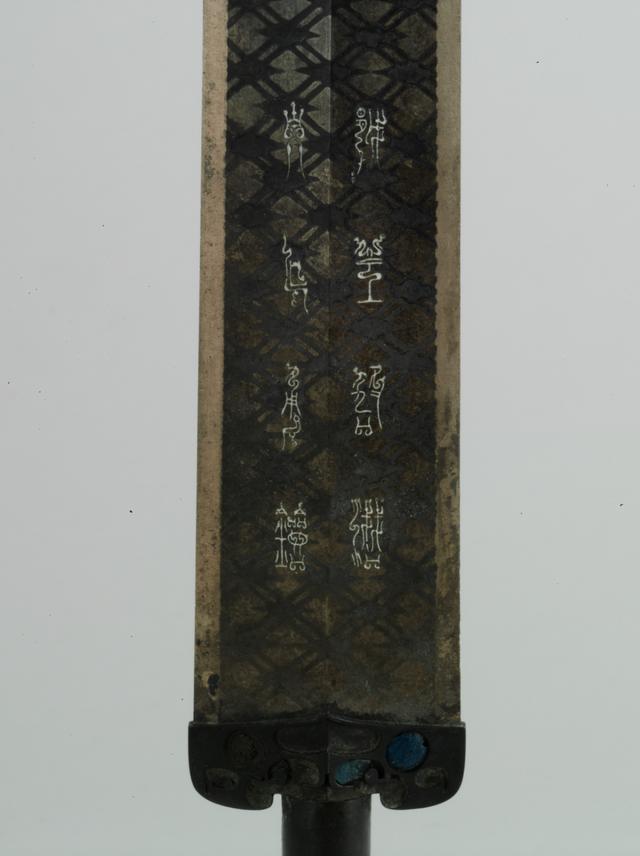 The inscriptions of “King of Yue Goujian” and “Self-acting Sword”. Photo provided by Hubei Provincial Museum
King Gou Jian of Yue did not come out of his hometown of Yue, but was buried in the tomb of the nobles of Chu. It should be a gift given to Chu by Yue. Archaeological experts said that the reason for the gift was that King Zhao of Chu married the daughter of King Goujian of Yue, and King Yue used this sword as a dowry and flowed into the State of Chu; or that Goujian gave the sword as a gift to the King of Chu in order to resist Wu.
According to Jiang Xudong, the King of Yue Goujian sword has been unearthed in 1965 and has carried out two systematic scientific testing and process research on it in the past 60 years.
Once, at the end of 1977, due to the need to shoot the scientific and educational film of “Ancient Sword”, the proton X fluorescence detection at Fudan University determined the alloy composition of different parts of the surface of Goujian sword, and also conducted research on the black diamond pattern process; in the end of 2017, in order to cooperate with the shooting of “National Treasure”, the Hubei Provincial Museum independently carried out the secondary research on the King of Yue Goujian sword. The research continued to be carried out with the development of non-destructive testing technology of cultural relics in Hubei Provincial Museum and equipment updates, and has been more than 7 years.
Jiang Xudong said that in this study, non-destructive testing equipment such as ultra-deep field microscope, X-fix detector, X-fluorescence spectrometer and other non-destructive testing equipment were mainly used to conduct comprehensive testing of the surface microscope, internal structure, and surface element distribution of Yue Wang Goujian sword. At the same time, through simulation experiments, its production process was verified and restored.
King Goujian of Yue is the hilt of the sword. Photo provided by Hubei Provincial Museum
Research shows that the sword body of the King Goujian of Yue Wang contains about 18%-20%, which is a common alloy component of Wuyue bronze sword; the whole body is cast in three sections: the sword body and the sword stem are cast in one piece, the sword grid is cast at the junction of the sword body and the sword stem, the concentric round sword head is cast separately, and then the cast and welding are connected to the end of the sword stem; the diamond pattern of the sword body is made by hot-dip tin.
In addition, experts speculate that the production process of King Goujian of Yue is:1. Cast the sword body and the sword stem in one piece; 2. Use hot-dip tin method to make diamond patterns on the sword body; 3. Grind and peel the sword body; 4. Cast a sword grid with grooves at the junction of the sword body and the sword stem; 5. Cast a concentric round sword head alone; 6. Cast welding to connect the sword head and the sword stem; 7. Inlaid blue glass and turquoise at the groove of the sword grid.
“According to this process, we restored the original craftsmanship of the King of Yue Goujian sword.” Jiang Xudong said that compared with the traditional King of Yue Goujian sword craftsmanship, this piece uses an alloy ratio similar to the original, and is cast separately in a concentric circle and then connected to the sword stem. It is a diamond pattern on the sword body, thus presenting the original appearance of the King of Yue Goujian sword intersecting with silver and yellow. It is currently the imitation piece closest to the original craftsmanship of the King of Yue Goujian sword.
reporter/Zhang Jianlin
edit/Zhang Qian
Proofreading/Liu Yue
Operations Editor/Fan Yijing