
This article is reproduced from: Southern Daily
Zhou Zhichen
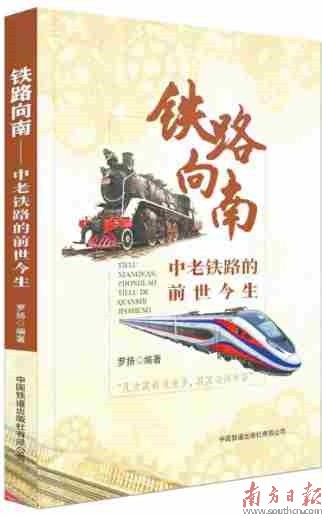
“Railway to the South”
by Luo Yang
China Railway Publishing House
September 2025
■Zhou Zhichen
Thirteen years ago, in Kunming, spring city in Yunnan, I co-founded the “Spring Reading Club” with a group of young people who love knowledge. At that time, Mr. Luo Yang always wore a simple outfit, with a laptop and a camera, sitting in the corner listening quietly, but showing his sharpness when asking questions. His eyes were both the keenness of a reporter and the rigor of an engineer. At that time, I didn't expect that this colleague, who was sometimes gentle and sometimes excited, would use the pen as the track and paper as the sleeper in the years to come to pave a magnificent scroll that runs through the development history of the Southwest Railway.
Luo Yang first published a non-fiction long work “Detailed Discussion on the Yunnan-Vietnam Railway” by Yunnan People's Publishing House. I was quite surprised when I got it. This book is sold out after three months of publication due to its unique charm. After the publication of “A Detailed Discussion on the Yunnan-Vietnam Railway”, Luo Yang did not stop and started writing the non-fiction long work “Railway to the South: From Shifo Railway to Zhonglao Railway” with greater ambition, courage and talent. It took more than four years to go. This book was finally published by China Railway Publishing House Co., Ltd., which is really gratifying and sincerely respectful.
Whether it is “A Detailed Discussion on the Yunnan-Vietnam Railway” or “Railway Going South”, the huge changes in mountains and rivers at the extension of the railway tracks are over. From the whistle sound of the Yunnan-Vietnam Railway a hundred years ago to the Fuxing River, which is flying on the China-Laos Railway today, Luo Yang used his words to melt the steel and bones of the railway with the humanistic blood of history, bringing people a magnificent picture that spans time and space. Its exploration, recording, thinking and questioning not only constitutes a legendary epic in the southwest corner of China's railway, but also retains precious archives from years of field surveys.
Luo Yang's ancestral home is Changsha, Hunan. His grandfather went to Kunming with the army liberated the southwest, so Luo Yang was the authentic “second generation of Kunming” and grew up in Kunming since childhood. Later, he was admitted to Southwest Jiaotong University and studied railway transportation. As a result, the family's great era migration was deeply imprinted on him – his grandfather advanced southwest due to a historical turning point, and his childhood memories were intertwined with the echoes of family and country narratives, the roar of flying over the mountains, and the sound of playing and chasing all day long on the railway tracks next to the dormitory of the former Yunnan Education College staff. This fateful connection gradually led him to grow from a vehicle inspector to a journalist. From then on, news became his eyes, and words were his heart. After years of experience, the cold and hard technology of the railway and the warmth of the fireworks on earth melted and merged into his heart, rushing into the lifeblood of his ideals.
In his more than ten years of journalism career, his footprints have spread across the mountains and ridges of Yunnan. From the wall slope tunnel of the first long tunnel of the Shanghai-Kunming High-speed Railway, to the tunnels such as Zongsi, Qidali, Mongolian Shuo, Yulong Snow Mountain, and Haba of the Lixiang section of the Yunnan-Tibet Railway, as well as the century-long hanging of the Jinshajiang Super Bridge, to the tunnels such as Xinping, Shitouzhai, Anding, and Friendship of the China-Laos Railway, and the shocking union of the Yuanjiang Double Line Super Bridge; from the national cultural protection of the Lixiang section of the Yunnan-Tibet Railway, to the cross-border tourism and trade exchanges of the Yumo section of the China-Laos Railway, he has always been the “first witness” at the railway construction site and the “devoted temperature measurer” of the people's livelihood after the railway is completed. His reports are never limited to the construction progress and data accumulation, but rather go deep into the construction site and visit villages, listen to the cold and hotness of road construction workers, and record the expectations and worries of the people along the route. His writing and writing have an underlying logic: the railway is the artery of the country, but every inch of the track is buried deep in the fate of ordinary people.
In “Railway to the South”, Luo Yang takes the “Shifo Railway” as the starting point and sinks into history. This provincial planned railway, born in the war of the War of Resistance Against Japan, was expected to become another international railway in Yunnan after the Yunnan-Vietnam Railway, carrying the tragic memory of the survival of the nation. He traveled between the vast historical materials and the vast fields, recreating the hardships of the Chinese people forging their dreams. In the chapter of the China-Laos Railway, he extended his brushstrokes to the grand plan of the “Belt and Road” and analyzed how this “golden channel” transformed Yunnan from a border into a hub, and Laos from a “land-locked country” to a “land-union country”. The interweaving of history and reality makes the whole book both have a profound sense of depth and a strong sense of time.
As a senior journalist, Luo Yang’s uniqueness lies in his dual sensitivity of both words and images. He uses the lens to see the subtle and freezes the light and shadow of the times. In his camera, there is mud on the faces of workers deep in the 765-meter underground in the Gaoligong Mountain Tunnel, the smiles of Dai girls on the China-Laos Railway, welcoming the first high-speed train in full costumes, and the bustling container fleet at the China-Laos border port. These pictures are not only evidence of news reports, but also vivid archives representing emotions.
In “Railway to the South”, Luo Yang selected more than 100 frames of photography, each frame is a affectionate gaze at the railway and people. There is a photo in the book that moved me particularly: in the sunset, two young miners stood beside the pony cart, one smiling and the other frowning. Without further description, this solidification moment has already told the vicissitudes of the century: isn’t the extension of the railway a microcosm of the fate of generations of Chinese people? Luo Yang's lens not only freezes the grandeur of the project, but also captures the body temperature of ordinary people with pulses at the same frequency as the steel track.
Luo Yang's writings are passionate and cold-thinking. He knew very well that railways are not only a collection of steel and technology, but also a complex carrier of regional economy, ecological protection and cultural heritage. When reporting on the Darui Railway, he interviewed geologists to analyze the construction problems of the Hengduan Mountains; when interviewing the Chongqing-Kunming High-speed Railway, he asked engineering experts to study the balance of line planning and biodiversity. This combination of “engineering thinking” and “humanistic sentiment” makes his works both professional and profound and public readable.
In this era of information explosion and traffic first, many peers were lost in fast-food reporting, and Luo Yang chose a path of “slow work and meticulous work”. He insisted on on-site interviews, so that a manuscript could travel thousands of miles; he refused to exaggerate titles, and always used facts and reason as the background of reporting. This kind of “stupid skill” made his works stand the test of time – from the sale of “Detailed Discussion on the Yunnan-Vietnam Railway” to the publication of “Railway to the South”, it all confirms the truth that “the focus will eventually become a craftsman”.
During the writing of “Railway to the South”, he revisited the ruins of Yunnan-Vietnam and Yunnan-Burma Railways, visited villages along the Zhonglao Railway, and even followed the construction team to go deep into the unmanned land. The details of the book that are full of earthiness will never be presented without personal experience. This almost paranoid spirit of truth-seeking makes this book a walking Southwest Railway encyclopedia.
Railways are a symbol of humiliation and rise in modern China. From the “meter rail” under the colonial intention of the great powers to the “quasi-rail” of going abroad; from the chaos of the “locomotive of the 100-country locomotive” to the leading position of independent innovation, every extension of the rail is marked by the awakening and leap of the nation. The “railway southward” that Luo Yang refers to is not only the direction of geography, but also a metaphor for China from chasing to leading.
After reading the whole book, I finally realized Luo Yang's persistence in committing to railway reporting. Because the railway carries not only goods and passengers, but also the ambition of a country and the belief of a group of people. The blasting sounds in the tunnel, welding flowers on the rails, and instructions in the dispatch room jointly wrote a modern version of Yugong Moving Mountain. And Luo Yang is the recorder and singer of this epic.
The publication of “Railways to the South” coincides with the fourth anniversary of the opening of the China-Laos Railway and the 12th anniversary of the proposal of the “Belt and Road” initiative. At this moment, among the mountains in Yunnan, the train was roaring south, crossing national borders, and heading towards everything. Luo Yang's words are like this express train of the times, carrying readers through the fog of history and towards the light of the future.
Pay tribute to all recorders who stick to their original aspirations like Luo Yang. May this book become a window for readers to understand China's railways and the changes of the times; may every story of the railway track inspire more people to move south and resonate with this land.
(The author is a senior media person and writer)