
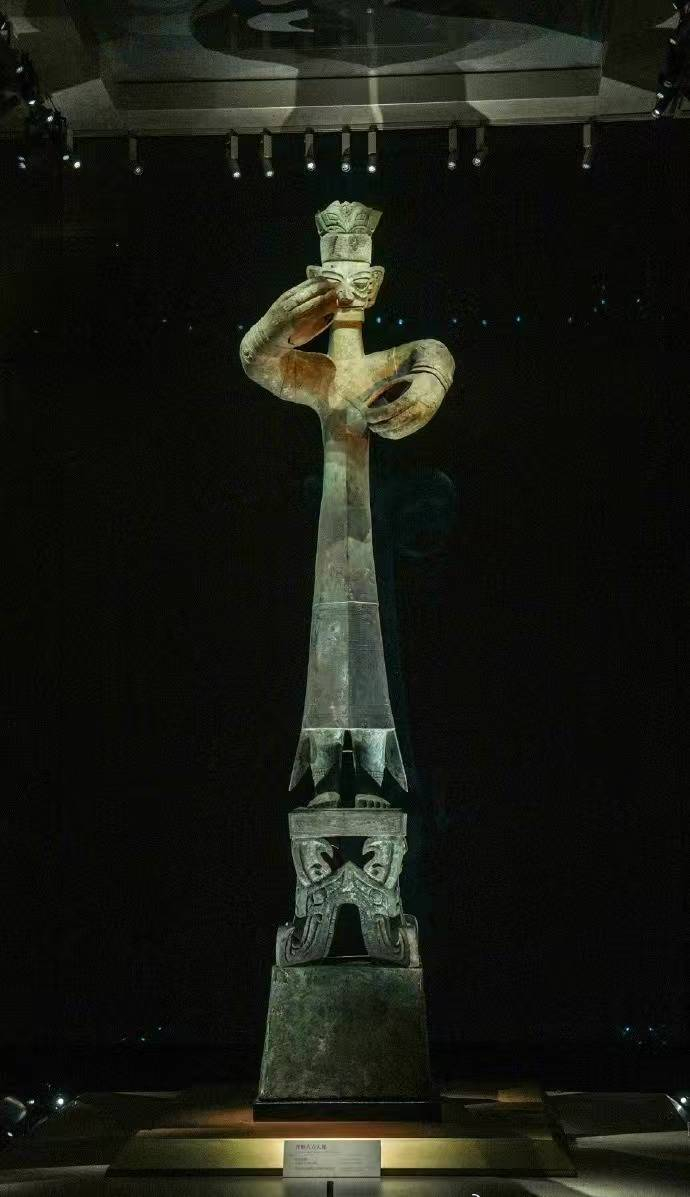
Cover news reporter Liu Ye
In 1986, the excavation of sacrificial pits No. 1 and 2 at the Sanxingdui site shocked the world. A large number of exquisite cultural relics were discovered, among which the large bronze statues and other bronzes were particularly eye-catching. These strangely shaped bronzes continue to trigger discussions: When were the Sanxingdui bronzes cast?
Most of the Sanxingdui bronzes were unearthed from sacrificial pits, and their casting ages vary. According to Sun Hua, a professor at the School of Archeology and Museology at Peking University and the academic dean of the Sanxingdui Research Institute, through horizontal comparison with bronzes with clear dates in the Central Plains region, it can be seen that the bronzes unearthed from the sacrificial pits at the Sanxingdui site were not cast earlier than the early Shang Dynasty. Its starting date is around the middle of the 13th century BC, which is equivalent to the Erligang Culture period in the Central Plains.
From the perspective of cultural factors, Professor Sun Hua said that some Erlitou cultural factors had already appeared in the Sichuan Basin much earlier. For example, the pottery tablets unearthed from the Sanxingdui site are one of the typical artifacts of the Erlitou culture. “Since the pottery with elements of the Erlitou Culture can be introduced to the Sichuan Basin and enter the Sanxingdui Culture, its bronze casting technology or bronze ware may also arrive in the Sichuan Basin.” “Although several of the Erlitou Culture-style inlaid turquoise bronze medallions found at the Sanxingdui site are from the Shang Dynasty, there should be undiscovered bronze medallions from the Erlitou Culture period.” Sun Hua further speculated.
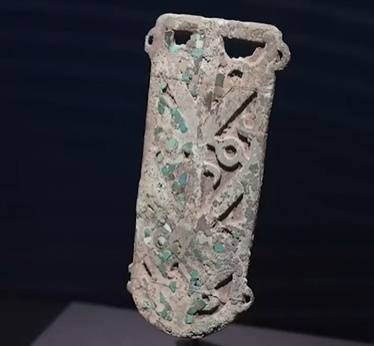 Turquoise bronze medal unearthed from Sanxingdui
It is noteworthy that archaeologists have discovered earlier bronze vessels and related remains around the Sichuan Basin, especially in the cultural transmission zones in the northwest and the eastern foothills of the Qinghai-Tibet Plateau. Sun Hua believes that whether the spread of these bronze techniques will also affect the Sanxingdui culture in the Sichuan Basin is also worth exploring.
No matter from the perspective of technology, culture, resources, etc., the communication and interaction network between Sanxingdui and surrounding areas seems to be very strong. Understanding the Sanxingdui bronzes is most likely inseparable from the exploration of this network.
According to Sanxingdui Museum