
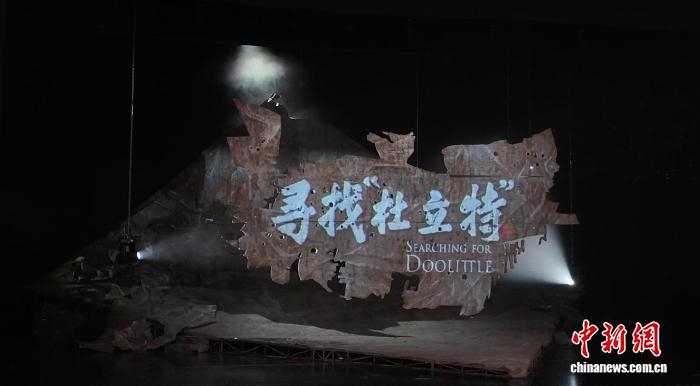
China News Service, Quzhou, November 14th (Zhang Bin) On November 14th, the premiere meeting of the original drama “Looking for “Dolittle”” was held in Quzhou, Zhejiang.
This work, jointly produced by the Propaganda Department of the Quzhou Municipal Committee of the Communist Party of China and the China Coal Mine Art Troupe, is based on the true history of the “Doolittle Operation Rescue” in 1942. It reproduces the “friendship forged by blood and fire” between the Chinese and American people at the important node of the 80th anniversary of the victory of the Chinese People's War of Resistance Against Japanese Aggression and the World Anti-Fascist War.
“Friendship Forged in Blood and Fire” is a story about justice.
Adhering to a correct historical view of World War II is a basic requirement to protect the historical truth and is related to the moral responsibility of human society. “Looking for “Doolittle”” shows the true history based on justice.
In April 1942, after U.S. Army Lieutenant Colonel Doolittle led 16 bombers to attack Japan, the crews of 15 aircraft were forced to abandon their planes and parachute over Zhejiang, Jiangxi, Fujian and other places. Chinese military and civilians in Quzhou, Zhejiang and other places spontaneously launched rescue operations and successfully rescued 64 U.S. pilots. The Japanese army subsequently launched a retaliatory campaign in Zhejiang and Jiangxi, resulting in the deaths of approximately 250,000 Chinese civilians.
In order to restore history, the creative team adheres to the narrative logic of “big events, small people”. “This work hopes to show the power of kindness and justice through the choices of ordinary people. It is not a simple war-themed drama.” Screenwriter Yang Shuo said frankly at the meeting that during the creation process, the creative team did not create a “perfect hero”, but focused more on the choices of ordinary people.
With delicate writing, the script focuses on the kind and simple farmers, the Southwest Associated University students who passionately serve the country, and the migrant workers who built the airport, etc., who resolutely launched a soul-stirring life-and-death rescue of the Allied pilots despite language barriers and personal danger. Through the perspective of a small character, the whole play shows the brilliance of human nature that transcends national boundaries and the deep-rooted kindness, justice and love of peace of the Chinese nation.
The central character in the play, Jiang Banchu, is an ordinary rural helper. In order to fulfill his friend's dying instructions, he embarks on the road of delivering messages, but is accidentally involved in the rescue of the US military pilot Manqi. “There was no official instruction in the rescue operation at first. The Chinese people came forward with only a simple sense of justice. This spontaneous kindness was even more shocking.” Yang Shuo said.
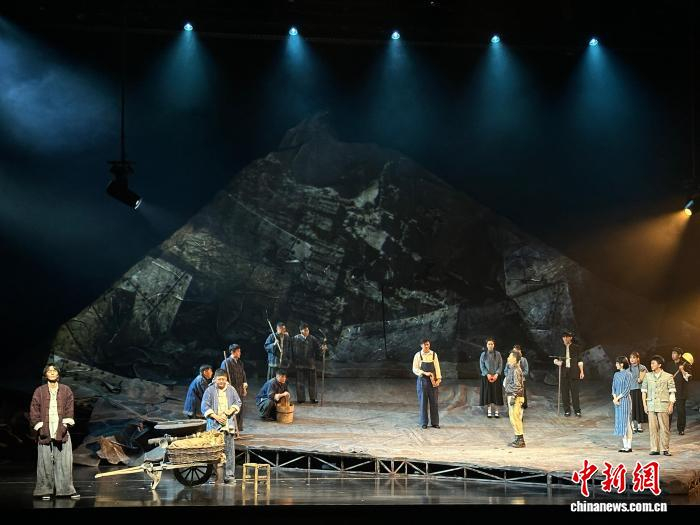 On the evening of November 13th, the preview was held. Photo by Zhang Bin
“Friendship Forged in Blood and Fire” is a story about friendship.
During the creation process, the team went deep into Quzhou for many times to collect stories, excavated a large amount of first-hand materials, integrated fragmented historical details into the plot, and mutually corroborated the records in the diaries of US military pilots.
According to director Zhong Hao, the biggest difficulty in this drama is how to balance the grand historical narrative with the depiction of the fate of individuals in the war. In the end, the creative team decided to use the concept of “fragments” to comprehensively condense sentences, individuals, and memories to create affectionate and meaningful characters on the stage.
In the play, the process of breaking down the barriers between Jiang Banchu and Manqi vividly interprets the word “love”. At first, Jiang Banchu was wary of Manqi because he was worried about his family's safety, but later became friends with him in the process of getting along with him; Manqi went from being anxious and uneasy at the beginning to taking out the pills he had with him for Jiang Banchu's family.
“This transformation was not deliberately designed, but stemmed from the true expression of feelings in the shared adversity.” Actor Helili Bogra, who plays Manchi, said that in order to get closer to the character, he made a special trip to visit the Dolittle Memorial Hall. Those real historical photos and objects gave him a deep understanding of “the brotherhood without words.”
“Jiang Banchu's 'cunning' and 'righteousness', and Manqi's 'vigilance' and 'gratefulness' are all true representations of human nature.” The two actors who play Jiang Banchu, Lu Yi and Wang Shanshui, said that the contradictions and growth of the characters make the characters' emotions more contagious.
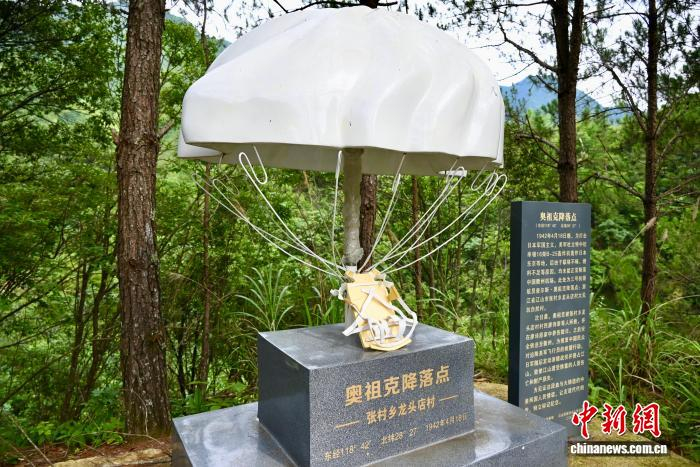 On July 16, Quzhou, Zhejiang, the monument where American pilot Charles Ozuk landed. Photo by Liu Zilin
“Friendship Forged in Blood and Fire” is a story about benevolence and righteousness.
“Quzhou is the Holy Land of Southern Confucius, and 'benevolence and righteousness' are the cultural genes of this land.” Wang Huilin, member of the Standing Committee of the Quzhou Municipal Party Committee and Minister of the Propaganda Department, said in her speech that day that the creation of the drama has always been rooted in the local culture of Quzhou, showing the kindness and tolerance of the Chinese people.
This kind of benevolence and righteousness is particularly vivid in the character Zhou Suzhen in the play.
Zhou Suzhen is an old country woman who lost her husband and son. She was initially repulsive to foreigners because of her unfamiliarity with foreigners. However, after the pilot showed his kindness, she was willing to take out her own coffin a hundred years later to bury the American crew members who died. She even agreed that her daughter-in-law would leave the family and help with the construction of the airport.
“Her transformation is gradual, from closed to open, which reflects the simplicity and benevolence of the Chinese people.” Actor Du Ninglin, who plays Zhou Suzhen, said that every time she performs the farewell scene, she can feel the concern that transcends blood ties.
“The creation process of this drama itself is a cooperation that spans mountains and seas.” Xu Jin, Party Secretary and Director of the China Coal Mine Art Troupe, said that since the launch of the project at the end of 2023, the team has spent two years polishing the script and revised the script several times. They have invited Wu Opera experts to teach, visited historical witnesses, and consulted military advisors, striving to find a balance between artistic authenticity and historical reality.
As the place where the story takes place, Quzhou has been committed to inheriting this precious friendship for many years. It has passed down the “friendship forged by blood and fire” from generation to generation by renovating and upgrading the Doolittle Action Memorial Hall, establishing a historical research association, protecting historical relics such as air raid shelters, and organizing Sino-US non-governmental exchange activities.
On November 15th and 16th, “Looking for Doolittle” will officially premiere at the Quzhou Poly Grand Theater. This far-reaching event finally returned to the place where the story took place and presented a more artistic expression on the stage. The relevant person in charge of the Propaganda Department of the Quzhou Municipal Party Committee said that in the future, the local government will promote the continuous polishing and improvement of the work, so that it can be better spread across the country and the world, so that more people can understand this period of history, promote non-governmental exchanges between China and the United States, and promote the correct historical view of World War II. (over)