
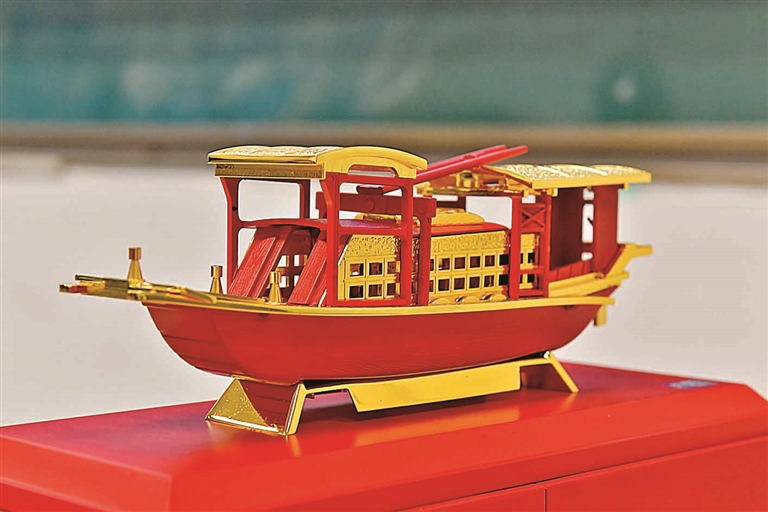
“The Red Boat”, Chen Zhizhong. To commemorate the 100th anniversary of the founding of the Communist Party of China in 2021, the wood grain effect was made with metal craftsmanship, and it was collected by the China Wood Carving Museum.
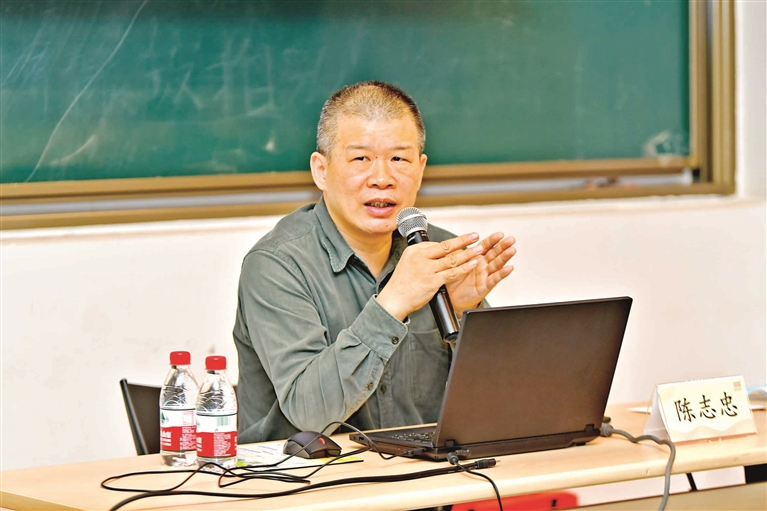
“Let the artwork live and life artistically, this is what the arts and crafts industry pursue.” On November 20th, Chen Zhizhong, a master of the Chinese industrial art industry and a craftsman from Shenzhen Pengcheng, visited the Baoan Cultural Tea House and brought his two This piece of work allowed the audience to experience the beauty of metal craftsmanship. From the perspective of a metal craftsman, they shared the legendary craftsmanship of the Yue Wang Goujian sword, which was “stainless for 2500 years and can easily cut more than 20 sheets of paper when unearthed.”
The Yue King Goujian sword is a treasure among the bronze weapons. It is known as the “No. 1 sword in the world”. It is now in the Hubei Provincial Museum. This sword has not been rusted after more than 2,000 years, and it can cut 20 to 30 layers of paper very easily. In 2006, the Hubei Provincial Museum copied 31 Yuewang swords, and Chen Zhizhong was asked to open the front of the imitation swords. During this process, Chen Zhizhong carefully observed the Yuewang sword, and verified with Tan Weisi, the leader of the cultural relics and archaeology team of the Hubei Provincial Museum when the sword was unearthed, and the deputy curator of the Hubei Provincial Museum at the time when the sword was unearthed. Based on these studies, Chen Zhizhong put forward some conjectures about the casting process of the Yue Wang Goujian sword that are different from the mainstream concepts.
First of all, the sharpness of the sword may not be due to the hardness of the sword, that is, the alloy ratio, but the technology of opening the front. “Of the 31 imitation swords, only five or six are relatively hard by themselves, but after my opening, each sword can easily cut 30 layers of paper.” Chen Zhizhong said, the sharpness of the Yuewang Goujian sword It is probably also brought about by the superb grinding and opening technology.
Secondly, this sword may not be cast as a whole, but made up of many parts. There are three reasons.
First, the length of the sword is 55.6 cm, and the width of the sword is 5 cm. The oxidation color of the sword body and the sword is completely different, indicating that the alloy ratio of the two parts is different. “Because according to the properties of the metal, if the material composition is the same, the degree of oxidation should be the same under the same conditions.” Chen Zhizhong said.
Second, in the place of the handguard and the scientific name of the sword grid, after the decorations such as colored glaze and turquoise have fallen off, a complete circular mark can be seen. This is an obvious pin position. This method is still used to make swords, including Swiss army knives, which are also fixed with pins. At the same time, this also shows that iron and drilling tools may already be available at that time.
Third, after the craftsman injects the vane into the copper liquid, the whole is quenched and quenched in cold water to ensure that the blade does not deform and warp after cooling. There is a row of honeycomb sand holes in the blade part 50 cm away from the sword grid. These loose sand holes are likely to be injection gates.
Baoan Daily reporter Luo Huiyi/Wen Songlu/Photo
■Interaction
Audience: How did you become interested in metal craftsmanship in the first place, and how did you maintain your interest and keep improving the technology?
Chen Zhizhong: At first, I was influenced by my family. My family used to be in the bamboo and wood business. My father studied casting. There are many books on casting and metal crafts at home. And I had a martial arts dream when I was a child, and I was very interested in swords, so I slowly began to ponder metal craftsmanship. Of course, I later learned that these sharp swords could not be made with the small stoves in martial arts novels.
In 1986, I did the carving of Barbie doll molds in the mold department of Hong Kong Kaida Company (Zhongtang Toy Factory). I learned from Mr. Luo Baoxuan and inherited a complete set of metal hand-carving skills that were on the verge of disappearing, and organically combined traditional handcrafts with modern equipment. In 1989, I came to Shenzhen and have been engaged in metal carving work in the production line.
I especially pursue the texture of sculpting. I carved and made the mascots of the CCTV Spring Festival Gala from 2003, 2009 to 2014. When I initially bid for the 2003 Spring Festival Gala mascot “Three Sheep Kaitai”, I took the eyes, eyelids and the stones at the feet of the sheep. The texture is made by hand.
As for how to continue to improve technology, I believe in one word, the heart is chasing. I like gardening and photography. I like observing things. I use a knife to simulate the texture of the photographed things.
Baoan Daily reporter Luo Huiyi