
In the history of China's aerospace industry, the name of Wang Yongzhi (1932-2024) shines like a bright star. He claims that he has only done three things in his life – developing missiles, sending satellites into space, and sending Chinese people into space.
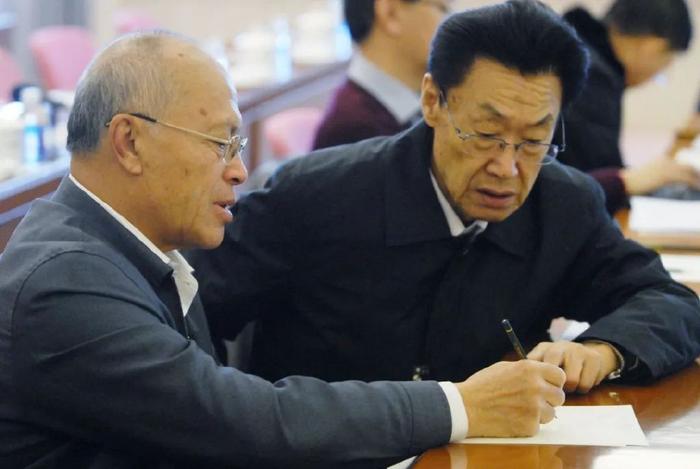
Academician of the Chinese Academy of Engineering and steam engineering expert Huang Qili (left) and Wang Yongzhi (right) are discussing (Source: “Knowledge is Power” magazine)
Having been engaged in the development of missiles and rockets for 30 years and the manned space industry for more than 20 years, Wang Yongzhi, the first chief designer of China’s manned space project and an academician of the Chinese Academy of Engineering, has devoted his life to the national defense scientific research and manned spaceflight of the motherland. In career. He has won the country's highest science and technology award, the title of “The Most Beautiful Struggler”, and was awarded the “Medal of the Republic” on September 13, 2024.

Aiming at aerospace and climbing to the top
In 1952, Wang Yongzhi, who was determined to devote himself to national defense construction, was admitted to the flight design major of the Department of Aeronautics of Tsinghua University with excellent results, and thus embarked on the journey to pursue his dream of aerospace.
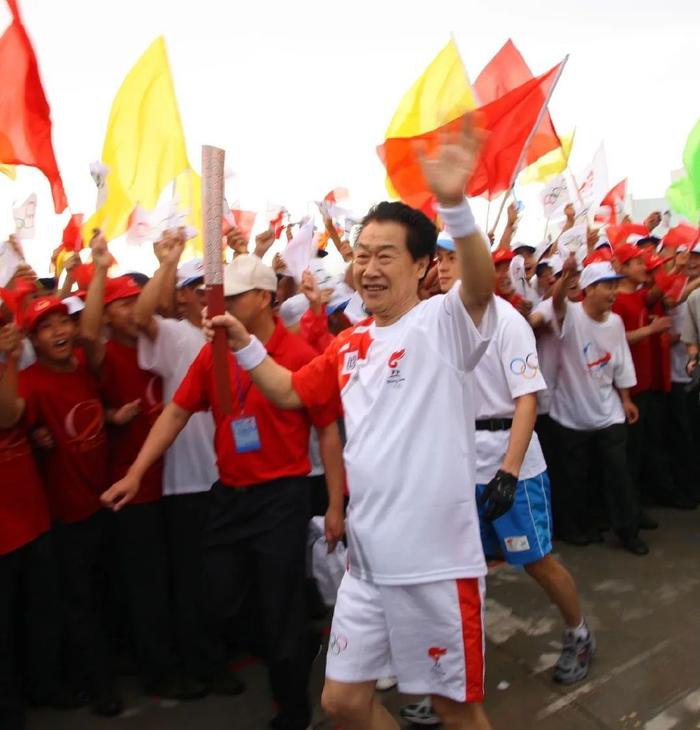
Wang Yongzhi (Photo source: “Knowledge is Power” magazine)
Under the call of the times, in 1955, he went to the Moscow Aviation Institute to study aircraft design. Two years later, due to national needs, Wang Yongzhi changed his studies to rocket and missile design. This decision not only changed his personal career path, but also heralded a new starting point for China's aerospace industry.
While studying in Moscow, Wang Yongzhi found his own scientific research direction. After completing his studies, he firmly refused when faced with his mentor's attempts to stay, because he had a bigger dream in his heart – that is, to return to the motherland and devote himself to the motherland's aerospace industry.

Reverse thinking and bold breakthroughs
After returning to China, Wang Yongzhi was assigned to China's first missile development institution, the Fifth Research Institute of the Ministry of National Defense, and was selected to focus on training young technological seedlings.
In 1964, Wang Yongzhi came to Jiuquan for the first time to participate in a missile launch mission.What will be launched this time is China's first self-developed medium-to-short-range missile, Dongfeng-2.It was late June, and the heat at the launch base was unbearable, but Wang Yongzhi was burning with a hotter flame – his love for science and his desire for the missile to successfully launch.
Due to high temperature expansion, the fuel tank could not be filled with enough fuel. Solutions were proposed again and again, but were denied again and again. During this process, after repeated thinking and calculations, Wang Yongzhi came up with a bold plan to maintain the mass of the oxidizer in the propellant and release 600 kilograms of fuel. Although the fuel was reduced, the rocket was lighter and could still reach the intended range.
In that era, this was a bold and innovative idea. For the fledgling Wang Yongzhi, it required great courage and wisdom. Experts did not adopt the young man's plan. Wang Yongzhi could only strengthen his confidence and courage to find Qian Xuesen. In the end, the Dongfeng-2, which was improved according to his suggestion, successfully took off. Sure enough, its range was improved, and three consecutive rounds entered the target area.

Dreams come true
Break the routine and use innovation to win the initiative
In September 1992, after five years of demonstration, China's manned space project was officially launched. This is the largest, most technically complex, and most demanding project in safety and reliability in China's aerospace history. 60-year-old Wang Yongzhi was officially appointed as the chief designer of the manned space project.
Faced with the huge gap with Western countries, Wang Yongzhi did not follow its technical route. Instead, he boldly adopted the idea of leapfrog development from the beginning of demonstration and project establishment, and led the team to carry out technological innovation.
The spacecraft is the core part of the manned space project.Wang Yongzhi directly aimed at the three-cabin spacecraft – the original propulsion cabin and return cabin remained unchanged.The decision was made to implement a major measure with Chinese characteristics, the use of orbital modules in orbit, which greatly improved the efficiency of the spacecraft.
Reliability first, safety first
In May 2006, Wang Yongzhi, who entered his 60th year, was transferred to the position of senior engineering consultant. During this period, he presided over the engineering design and technical work of the four Shenzhou 1 to 4 flight tests as well as the Shenzhou 5 and 6 manned space flights.
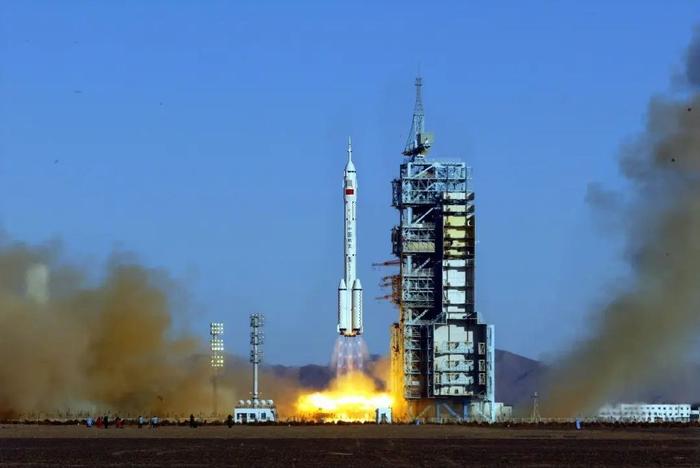
The Shenzhou 5 manned spacecraft was launched by the Long March 2F carrier rocket
(Photo source: “Knowledge is Power” magazine)
From unmanned to manned, from carrying one astronaut to carrying two astronauts, the difficulty is getting higher and higher, and the tasks are getting heavier and heavier, but Wang Yongzhi always values the safety of astronauts.
Before the launch of the Shenzhou-5 manned spacecraft, he personally checked every safety measure to ensure nothing went wrong. At 6:23 on October 16, 2003, my country's first manned spacecraft Shenzhou 5 successfully returned to the ground. When astronaut Yang Liwei walked out of the hatch, Wang Yongzhi shed tears of excitement…
After joining the Communist Party of China in 1949, Wang Yongzhi's fate was intertwined with the fate of the country. Wang Yongzhi's life is a life of struggle, a life of innovation, and a life of dedication. He used his wisdom and sweat to write a glorious chapter in China's aerospace industry and set a glorious example for his successors.

Written by | Li Yanhan
Editor in charge | Wang Jiaxuan, Duan Yangyang
Operations Editor | Duan Yangyang
Quality Audit | Ye Lei
❖ Article source: “Knowledge is Power” magazine
《Wang Yongzhi: The founder of China’s manned spaceflight dream》 ❖