
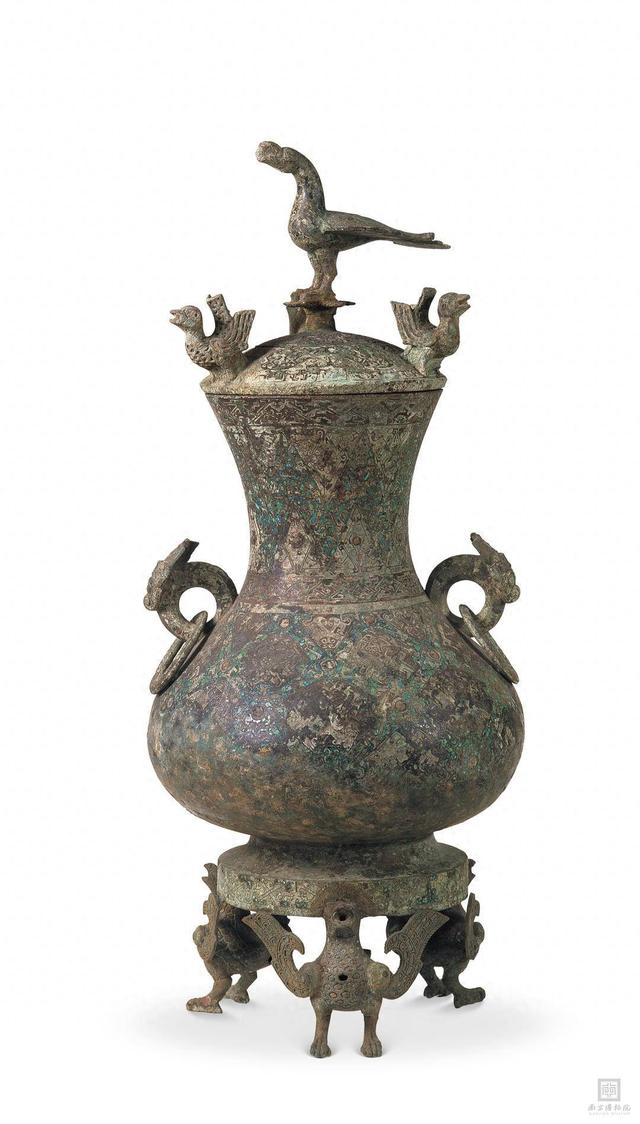
Sixty years ago, a bronze vessel was unearthed from a Western Han Dynasty tomb in Sanlitun, Lianshui, Huai'an. There is a flying bird on the cover button, and three flying birds around the cover and at the feet. The ears are made of animal faces, and the whole body is staggered with silver and inlaid with turquoise. The strange shape and exquisite casting technology are considered to represent the high achievements of bronze casting and decoration technology during the Warring States Period. This is a first-class national cultural relic in the Nanjing Museum.
The copper kettle is 63 centimeters high, with a solemn and straight overall shape. The body is oblate, the neck is slightly drawn inward, and the round foot is extravagant. There is a cylindrical button in the center of the cover, and there is a bronze bird with wings spread on the top of the button. Three flying birds of the same shape are equidistantly distributed on the edge of the cover, echoing the three birds surrounding the bottom of the circle. The ears are located on both sides of the pot neck. The ears are embossed with animal mask patterns. The animal eyes are wide open and the fangs are exposed. It has a typical decorative style of Warring States bronzes. Records show that although the tomb unearthed in this copper pot belongs to the Western Han Dynasty, the funerary objects include many bronzes from the Warring States period. Archaeological research shows that this pot should be a artifact of the nobles of the Warring States Period, and was later collected by the nobles of the Han Dynasty and used as a funerary object.
It is worth noting that the surface of the copper pot adopts a silver-staggered process, with fine silver wires embedded in geometric interlocking cloud patterns. The patterns are complex but not chaotic, and the turning points are smoothly connected. Some areas are inlaid with turquoise, and the gems and silver lines complement each other, creating a strong visual contrast. Made in the shape of a flying bird, the beak is slightly open, the wings are spread out in a suspended posture, and the details are processed with precision.
According to experts, as a typical example of gold and silver mismatched wares during the Warring States Period, this copper pot combines three major processes: casting, inlaying, and gold and silver mismatching: the main body is molded by the mold casting method; the mismatched silver pattern requires first casting a groove, and then hammering the silver wire into the groove; turquoise inlay requires pre-calculation of the size of the gemstone and reserved inlay holes. In particular, the conception of the flying birds on the ceiling reflects the craftsmen's ability to observe natural creatures during the Warring States Period, and provides important evidence for the study of naturalistic tendencies in Warring States art. In addition, the geometric patterns on the body of the vessel are characteristic of Chu culture, and the continuous interlocking cloud patterns may be a metaphor for the religious concept of communication between heaven and earth. This artifact integrates the functions of a practical vessel, a ritual vessel, and a work of art. It is a key material for studying the social hierarchy and the development level of craftsmanship during the Warring States Period.
Yangzi Evening News/Ziniu News reporter Zhang Ke/Text
Image source: Nanjing Museum
Proofreading by Tao Shanggong