
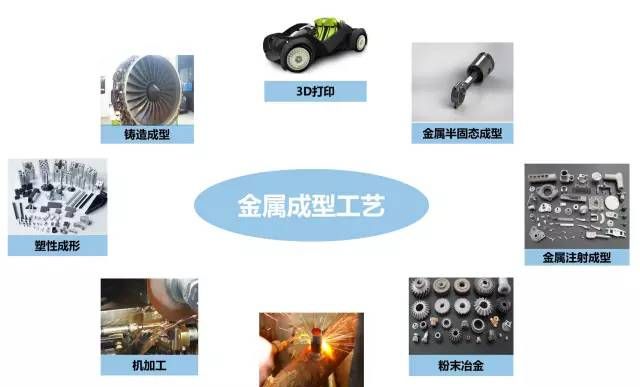
Source: Metal Online
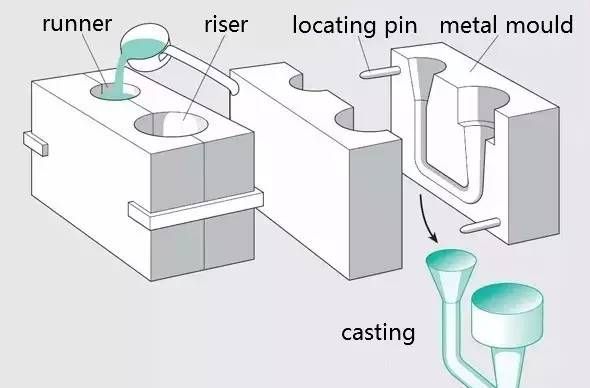
The liquid metal is poured into the mold cavity suitable for the shape and size of the part, and it is cooled and solidified to obtain the production method of the blank or part, which is usually called metal liquid forming or casting.
Process flow:Liquid metal filling solidification shrinkage castings
Process features:
1. It can produce parts with any complex shape, especially the parts with complex inner cavity shape.
2. Strong adaptability, unlimited alloy types, almost unlimited casting size.
3. Wide source of materials, remelting of waste products, and low investment in equipment.
4. High rejection rate, low surface quality and poor working conditions.
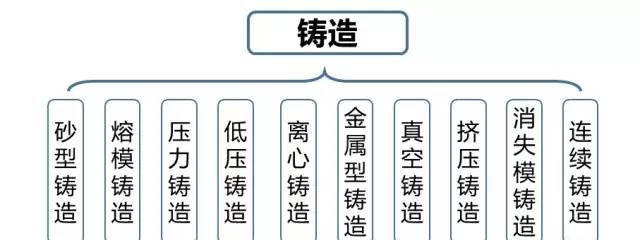
Casting classification:
(1) Sand casting (sand casting)
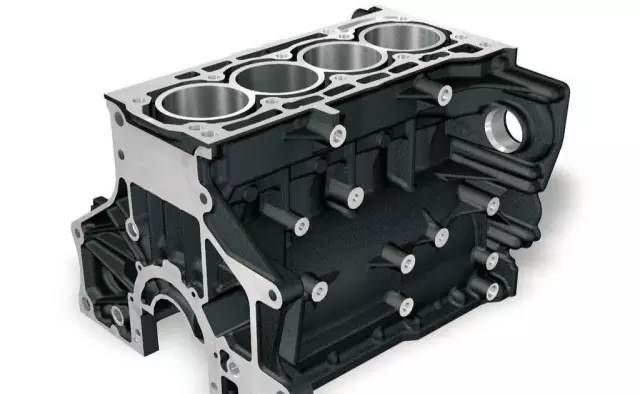
Sand casting:Casting method for producing castings in sand moulds. Steel, iron and most non-ferrous alloy castings can be obtained by sand casting.
Process flow:
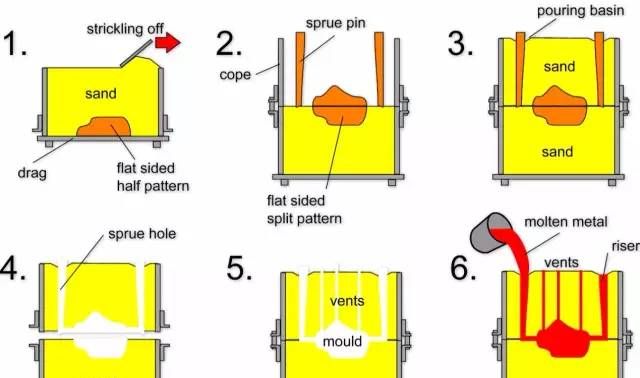
Sand casting process
Technical features:
1. It is suitable for making blanks with complex shapes, especially with complex inner cavities;
2. Wide adaptability and low cost;
3. For some materials with poor plasticity, such as cast iron, sand casting is the only forming process for making their parts or blanks.
application:Automobile engine cylinder block, cylinder head, crankshaft and other castings
(2) Investment casting
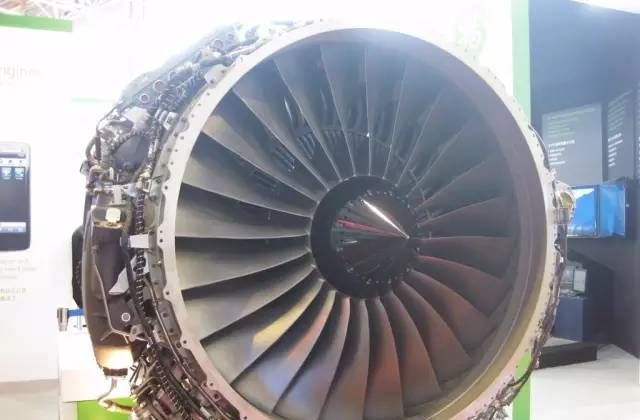
Investment casting:It usually refers to making a pattern in fusible material, coating the surface of the pattern with several layers of refractory material to make a mold shell, and then melting the pattern out of the mold shell to obtain a mold without parting surface, which can be filled after high temperature baking. Casting solution for sand pouring. Often referred to as “lost wax casting”.
Process flow:
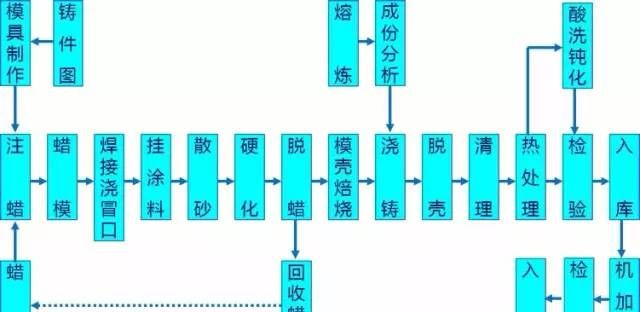
Investment casting process
Process characteristics
advantage:
1. High dimensional accuracy and geometric accuracy;
2. High surface roughness;
3. It can cast complex castings, and the alloys to be cast are not limited.
shortcoming:The process is complicated and the cost is high
application:It is suitable for the production of small parts with complex shapes, high precision requirements, or difficult to perform other processing, such as blades of turbine engines.
(3) Die casting
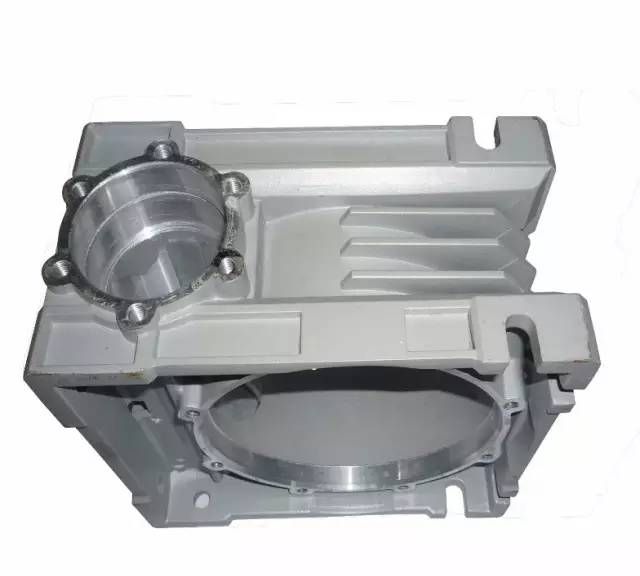
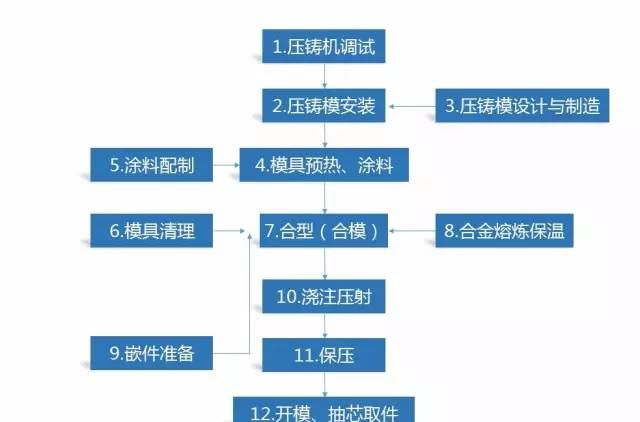
Die casting:It uses high pressure to press the molten metal into the cavity of a precision metal mold at a high speed, and the molten metal cools and solidifies under the action of pressure to form a casting.
Process flow:
advantage:
1. During die casting, the metal liquid is subjected to high pressure and fast flow rate
2. Good product quality, stable size and good interchangeability;
3. The production efficiency is high, and the die-casting mold is used many times;
4. It is suitable for mass production and has good economic benefits.
shortcoming:
1. Castings are prone to small pores and shrinkage.
2. The plasticity of die castings is low, and it is not suitable to work under impact load and vibration;
3. When the high melting point alloy is die-casting, the life of the mold is low, which affects the expansion of die-casting production.
application:Die castings were first used in the automobile industry and instrument industry, and later gradually expanded to various industries, such as agricultural machinery, machine tool industry, electronics industry, defense industry, computers, medical equipment, clocks, cameras and daily hardware.
(4) low pressure casting (low pressure casting)
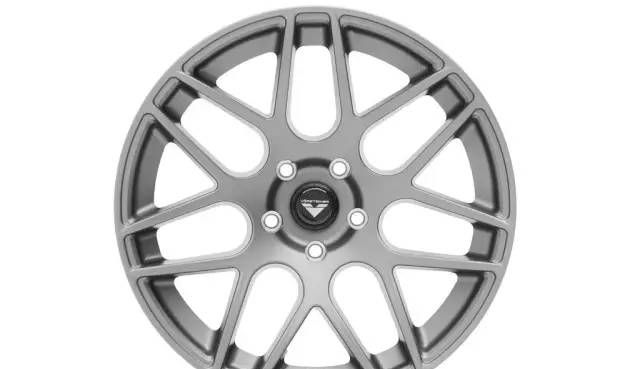
Low pressure casting:It refers to the method of filling the mold with liquid metal under lower pressure (0.02-0.06MPa) and crystallizing under pressure to form a casting.
Process flow:
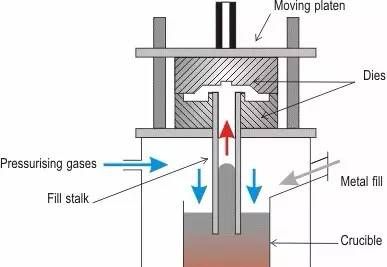
1. The pressure and speed during pouring can be adjusted, so it can be applied to various molds (such as metal molds, sand molds, etc.), casting various alloys and castings of various sizes;
2. The bottom injection type filling is adopted, the metal liquid filling is stable, and there is no splash phenomenon, which can avoid the gas involved and the erosion of the wall and core, and improve the qualification rate of castings;
3. The casting crystallizes under pressure. The casting has a dense structure, clear outline, smooth surface and high mechanical properties, which is especially beneficial for the casting of large and thin-walled parts;
4. The feeding riser is omitted, and the metal utilization rate is increased to 90-98%;
5. Low labor intensity, good labor conditions, simple equipment, easy to realize mechanization and automation.
application:Mainly traditional products (cylinder heads, wheel hubs, cylinder frames, etc.).
(5) Centrifugal casting
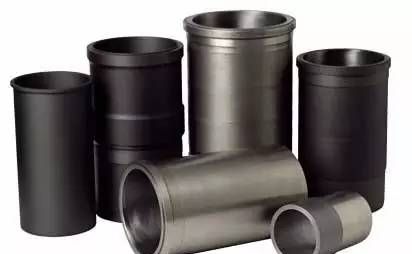
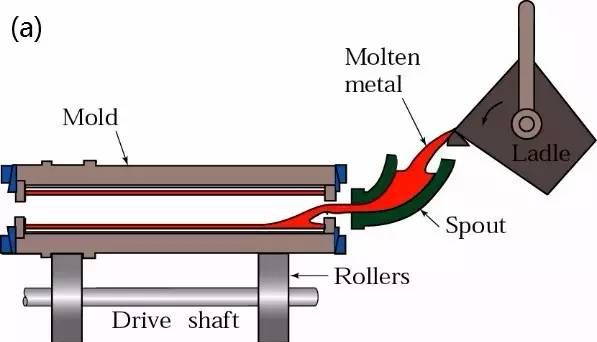
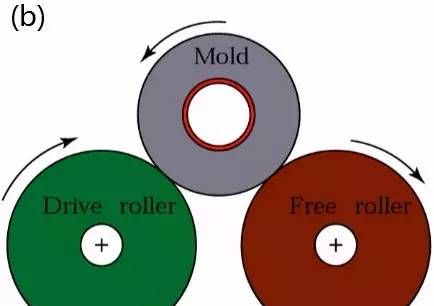
Centrifugal casting:It is a casting method in which molten metal is poured into a rotating mold, and the mold is filled and solidified under the action of centrifugal force.
Process flow:
advantage:
1. There is almost no metal consumption of the gating system and the riser system, which improves the process yield;
2. The core can not be used in the production of hollow castings, so the metal filling ability can be greatly improved in the production of long tubular castings;
3. The casting has high density, less defects such as pores and slag inclusions, and high mechanical properties;
4. It is convenient to manufacture cylinder and sleeve composite metal castings.
shortcoming:
1. There are certain limitations when used to produce special-shaped castings;
2. The diameter of the inner hole of the casting is inaccurate, the surface of the inner hole is relatively rough, the quality is poor, and the machining allowance is large;
3. Castings are prone to specific gravity segregation.
application:
Centrifugal casting was first used to produce cast pipes. Centrifugal casting processes are used in metallurgy, mining, transportation, irrigation and drainage machinery, aviation, national defense, automobiles and other industries at home and abroad to produce steel, iron and non-ferrous carbon alloy castings. Among them, the production of castings such as centrifugal cast iron pipes, internal combustion engine cylinder liners and shaft sleeves is the most common.
(6) Gravity die casting
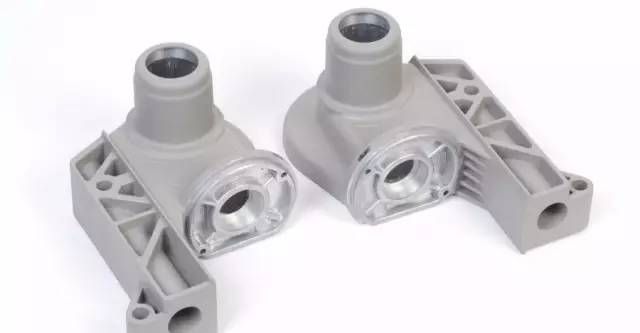
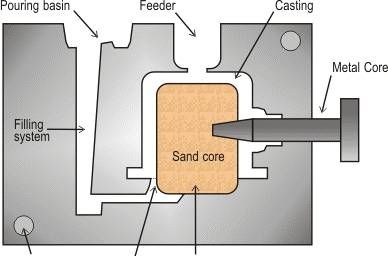
Metal mold casting:It refers to a molding method in which liquid metal fills a metal mold under the action of gravity and cools and solidifies in the mold to obtain a casting.
Process flow:
advantage:
1. The thermal conductivity and heat capacity of the metal mold are large, the cooling rate is fast, the structure of the casting is dense, and the mechanical properties are about 15% higher than that of the sand casting.
2. Castings with higher dimensional accuracy and lower surface roughness value can be obtained, and the quality stability is good.
3. Because sand cores are not used or rarely used, the environment is improved, dust and harmful gases are reduced, and labor intensity is reduced.
shortcoming:
1. The metal mold itself has no air permeability, and certain measures must be taken to export the air in the cavity and the gas generated by the sand core;
2. The metal mold has no concession, and cracks are easy to occur when the casting is solidified;
3. The metal mold manufacturing cycle is long and the cost is high. Therefore, good economic results can only be shown when mass-produced in batches.
application:Metal mold casting is not only suitable for mass production of non-ferrous alloy castings such as aluminum alloys and magnesium alloys with complex shapes, but also for the production of iron and steel metal castings and ingots.
(7) vacuum die casting
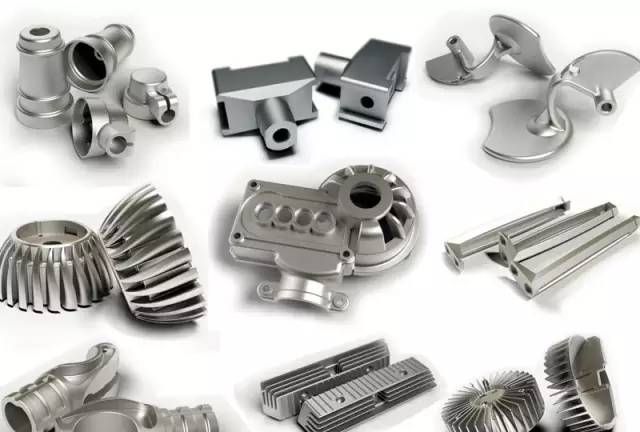
Vacuum casting:An advanced die-casting process that eliminates or significantly reduces the pores and dissolved gases in the die-casting part by removing the gas in the die-casting mold cavity during the die-casting process, thereby improving the mechanical properties and surface quality of the die-casting part.
Process flow:
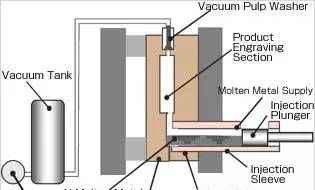
advantage:
1. Eliminate or reduce the pores inside the die casting, improve the mechanical properties and surface quality of the die casting, and improve the coating performance;
2. To reduce the back pressure of the cavity, lower specific pressure and alloys with poor casting properties can be used, and it is possible to use small machines to die-cast larger castings;
3. The filling conditions are improved, and thinner castings can be die-cast;
shortcoming:
1. The mold sealing structure is complex, and it is difficult to manufacture and install, so the cost is high;
2. If the vacuum die casting method is not properly controlled, the effect will not be very significant.
(8) Squeeze die casting
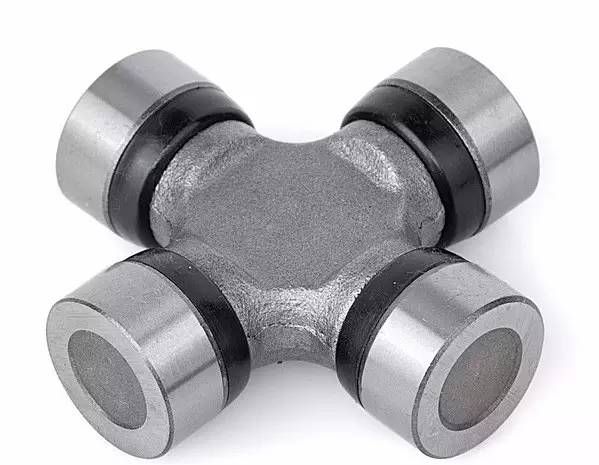
squeeze casting: It is a method of solidifying liquid or semi-solid metal under high pressure, flow forming, and directly obtaining parts or blanks. It has the advantages of high utilization rate of liquid metal, simplified process and stable quality, etc. It is an energy-saving metal forming technology with potential application prospects.
Process flow:
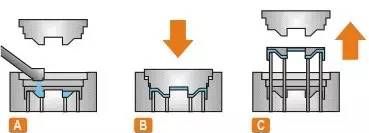
Direct Squeeze Casting:Spray paint, pour alloy, mold clamping, pressurization, pressure maintaining, pressure relief, mold parting, blank demoulding, reset;
Indirect squeeze casting:Spray paint, mold clamping, feeding, mold filling, pressurization, pressure keeping, pressure relief, mold parting, blank demoulding, reset.
Technical features:
1. It can eliminate internal defects such as pores, shrinkage holes and shrinkage porosity;
2. Low surface roughness and high dimensional accuracy;
3. It can prevent the occurrence of casting cracks;
4. It is convenient to realize mechanization and automation.
application:Can be used to produce various types of alloys, such as aluminum alloys, zinc alloys, copper alloys, ductile iron, etc.
(9) Lost foam casting)
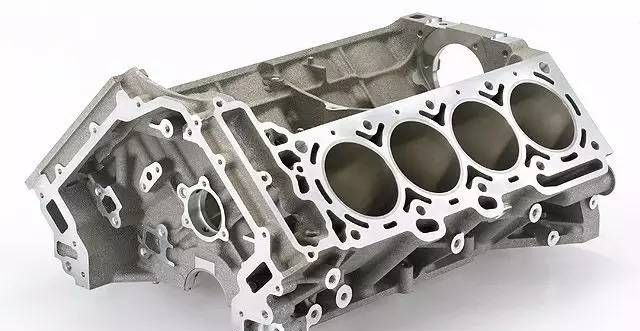
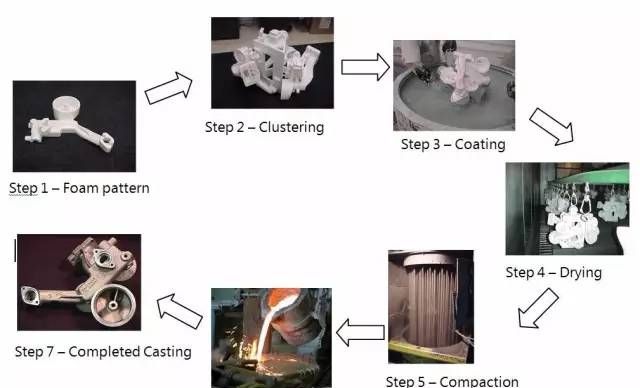
Lost foam casting (also known as solid casting):It is to bond and combine paraffin or foam models similar in size and shape to castings into model clusters. After brushing refractory paint and drying, they are buried in dry quartz sand to vibrate for modeling, and poured under negative pressure to vaporize the model and liquid metal. A new casting method that occupies the position of the model and forms a casting after solidification and cooling.
Process flow:Pre-foaming, foaming, molding, dipping, coating, drying, molding, pouring, sanding, cleaning
1. The casting has high precision and no sand core, which reduces the processing time;
2. No parting surface, flexible design and high degree of freedom;
3. Clean production, no pollution;
4. Reduce investment and production costs.
application:It is suitable for the production of precision castings of various sizes with complex structures, unlimited types of alloys and unlimited production batches. Such as gray cast iron engine case, high manganese steel elbow, etc.
(10) Continuous casting
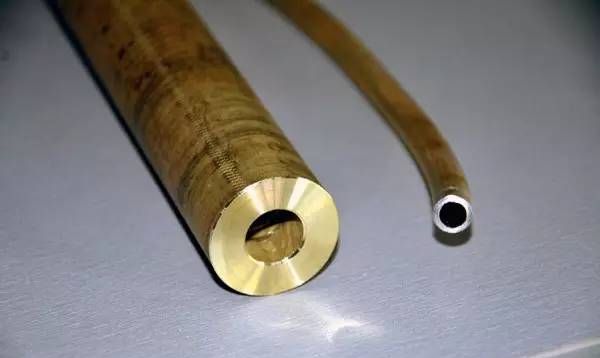
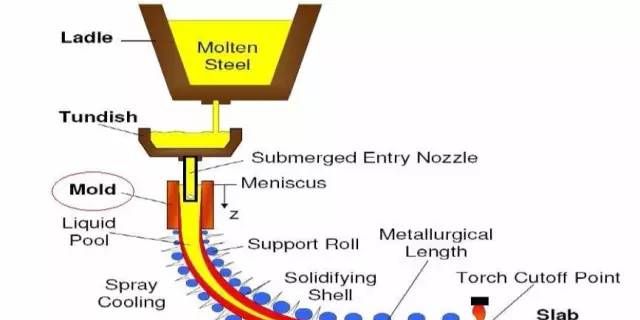
Continuous casting:It is an advanced casting method, the principle of which is to continuously pour molten metal into a special metal mold called a mold, and the solidified (crust) casting is continuously pulled out from the other end of the mold. , it can obtain castings of any length or a specific length.
Process flow:
1. Because the metal is rapidly cooled, the crystallization is dense, the structure is uniform, and the mechanical properties are good;
2. Save metal and improve yield;
3. The process is simplified, and the modeling and other processes are eliminated, thus reducing the labor intensity; the required production area is also greatly reduced;
4. Continuous casting production is easy to realize mechanization and automation, and improve production efficiency.
application:Continuous casting can be used to cast steel, iron, copper alloy, aluminum alloy, magnesium alloy and other long castings with constant cross-sectional shape, such as ingots, slabs, billets, pipes, etc.