
In recent years, the design service temperature of some heat-resistant components in key fields such as civil light engines, aerospace and national defense has gradually spanned the range of 250-400°C, and higher requirements have been placed on the service life under high temperature and load. Lightweight aluminum and magnesium alloys are the second lightest and lightest engineering alloy material systems, respectively, and are the preferred lightweight materials for heat-resistant components below 400°C. However, the melting point of aluminum and magnesium alloys is only about 500-630 °C, and the nano-precipitated phase that is strengthened in the matrix will rapidly coarsen from tens to hundreds of nanometers to hundreds of nanometers under high temperature and load conditions above 250 °C Even in the order of microns, resulting in a sharp decline in high temperature mechanical properties and service life.
Recently, Dr. Dong Xixi and co-tutor Prof. Ji Shouxun from the National Liquid Metal Engineering Center (LiME Hub) and Brunel Center for Advanced Solidification Science and Technology (BCAST), Brunel University, London, UK, reported a new kind of magnesium alloy through years of exploration and research. Innovative aluminum-based short-range (0-2nm)/clusters with smaller size, higher number density, higher resistance to high temperature and stress coarsening/creep than traditional tens to hundreds of nanometer-scale nano-precipitation strengthening phases (2-10 nanometers) strengthened microstructure, coherent with the magnesium matrix, overcoming the scientific problem of rapid coarsening of the traditional nanoprecipitation strengthening phase at high temperatures and loads above 250 °C, and changing the long-term benefits of aluminum for magnesium liquid formability It is not conducive to the traditional understanding of its high-temperature mechanical properties. It realizes the coordinated improvement and regulation of aluminum’s liquid forming ability and high-temperature mechanical properties of die-casting magnesium alloys, and greatly increases the high-temperature service temperature of die-casting magnesium alloys from 120-200°C to 250-350°C. °C.
The related results were published in the top journal “Acta Materialia” in the field of metal structural materials under the title “On the exceptional creep resistance in a die-cast Gd-containing Mg alloy with Al addition”. Dr. Dong Xixi is the first and corresponding author of the paper, and Professor Ji Shouxun is the corresponding author of the paper. Researcher Gang Ji from the University of Lille in France is the main collaborator of the paper. BCAST Ph.D. students Feng Lingyun, Dr. Wang Shihao, and Professor Yang Hailin of Central South University also contributed to the publication of the research work.
Paper link:
https://doi.org/10.1016/j.actamat.2022.117957
Based on this, the deep lightweight and high heat-resistant die-casting magnesium alloy for light-duty engine combustion chamber piston (300-350°C) was developed after working at 300°C/50MPa for 400 hours. nanometer, and is compatible with the magnesium matrix, and the steady-state creep rate at 300°C/50MPa is as low as 1.35×10⁻¹⁰s-1 and can be safely used for 600 hours. The high temperature resistance and stress roughening/creep performance are almost publicly reported. The best of magnesium alloys and aluminum alloys.
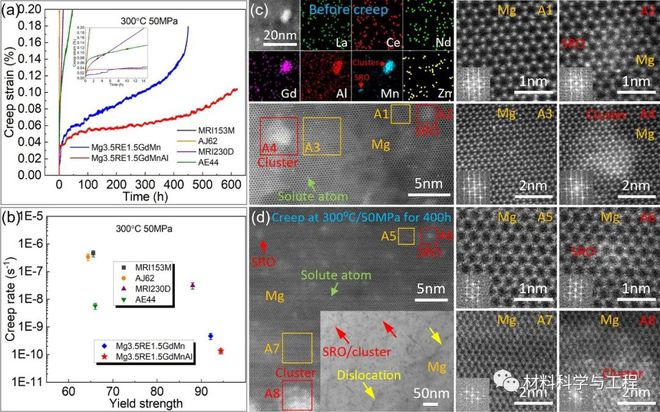
Fig. 1 The discovery of high temperature resistance and stress coarsening/creep super-short program/cluster microstructure in lightweight magnesium alloys and the new high heat-resistant die-casting magnesium alloys (a, b) developed accordingly at 300°C/50MPa Creep properties under ; (c,d) High heat-resistant Al-based short-range (0-2 nm)/cluster (2-10 nm) strengthened microstructure in Mg matrix (c) Before creep, (d) After 400 hours of creep at 300°C/50MPa.
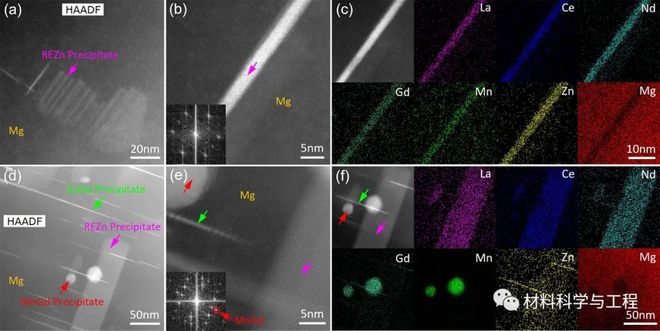
Fig.2 Coarsening evolution of traditional tens to hundreds of nanometer-scale nanoprecipitation-strengthening phases in comparative die-cast magnesium alloys without Al addition under high temperature and stress conditions: (ac) Before creep; (df) 300°C/50MPa creep After 400 hours.
This study substantially improves the high temperature resistance and stress coarsening/creep performance of lightweight magnesium alloys, and gives some high thermal stability short program (0-2 nm)/cluster (2-10 nm) strengthening microstructures. The experimental evidence that the structure can be stable for a long time under high temperature and high stress service environment answers the academic and engineering community’s doubts that short-program/cluster strengthened microstructures may not be stable for a long time under high temperature and high stress service environment.
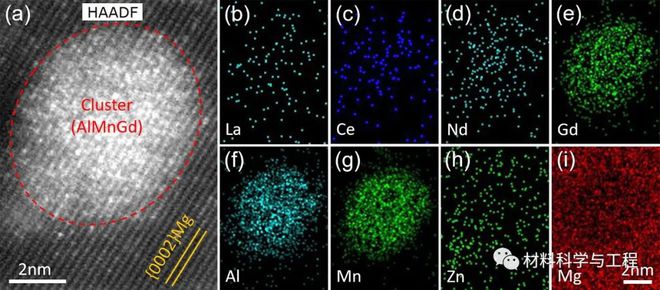
Fig.3 STEM/EDS of the high heat-resistant Al-based short-program (0-2 nm)/cluster (2-10 nm) reinforced microstructure in the new high-heat-resistant die-casting magnesium alloy (300°C/50MPa creep for 400 hours) in the matrix Chemical element enrichment map.
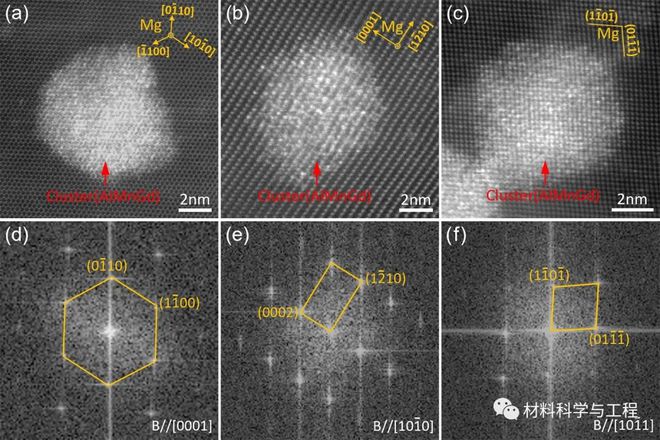
Fig. 4 Atomic-level resolution of the microstructure reinforced by the short program (0-2 nm)/cluster (2-10 nm) in the matrix of the new high heat resistant die-casting magnesium alloy (300°C/50MPa creep for 400 hours) Rate STEM-HAADF images: high heat-resistant Al-based short programs/clusters coherent with Mg-based matrix.
This research provides a new direction for the design of superheat-resistant light alloys, and it is expected that the short-range (0-2 nm)/cluster (2-10 nm) strengthening microstructure with high thermal stability will be an innovative The theory and method to solve the scientific problem of rapid coarsening/creep of traditional tens to hundreds of nanometer-scale nano-precipitation strengthened phases under high temperature and stress conditions are expected to play an important role in the design of high heat-resistant and long-life superalloys in the future.

Fig.5 High-density high-heat-resistance Al-based short program (0-2 nm)/cluster (2-10 nm) in the matrix of a new type of high-heat-resistance die-casting magnesium alloy (300°C/50MPa creep for 400 hours) strengthens the microstructure paralocation Wrong pinning.
This research has applied for PCT international patent, and it has gone through many years from research and development, pilot test, patent application to industrial application. The research results have important scientific and engineering significance for the deep lightweight, heat resistance and life improvement of high temperature service components in key fields.