
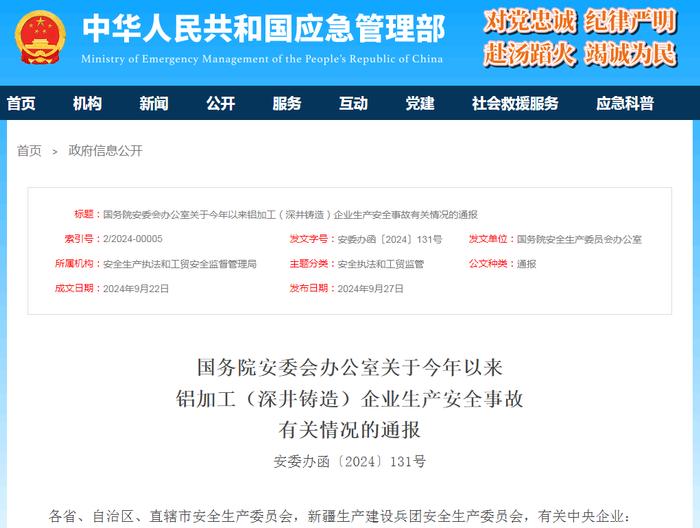
Beijing News On September 27, the Office of the State Council Safety Committee issued a notice on production safety accidents in aluminum processing (deep well casting) enterprises this year. The full text of the notice is as follows:
Work Safety Committees of all provinces, autonomous regions, and municipalities directly under the Central Government, Work Safety Committee of Xinjiang Production and Construction Corps, and relevant central enterprises:
Since the beginning of this year, production safety accidents at aluminum processing (deep well casting) enterprises (hereinafter referred to as enterprises) have been frequent. Four explosion accidents have occurred, resulting in 15 deaths and 38 injuries. The safety production situation is very serious. On August 31, an explosion occurred in the melting and casting workshop of Shanxi Southeast Precision Technology Co., Ltd. (hereinafter referred to as Southeast Precision) in Luliang City, Shanxi Province, when liquid aluminum encountered water, causing 3 deaths and 10 injuries; on July 26, an explosion occurred in Henan, Shangqiu City, Henan Province An explosion of aluminum liquid when exposed to water occurred in the deep well casting workshop of Zhongrui Nonferrous Metal Materials Co., Ltd. (hereinafter referred to as Zhongrui Nonferrous Metal Materials Co., Ltd.), resulting in 5 deaths and 14 injuries; on July 9, Fen'an Aluminum Co., Ltd., Fuzhou City, Fujian Province (hereinafter referred to as Fen'an Aluminum) An explosion of aluminum liquid when exposed to water occurred in the casting workshop, resulting in 2 deaths and 1 injury; on February 18, Nantong City, Jiangsu Province Asia Pacific Light Alloy (Nantong) Technology Co., Ltd. (hereinafter referred to as Asia Pacific Light Alloy) An explosion occurred when molten aluminum met water in the smelting workshop, killing 5 people and injuring 13 others. These accidents had a great social impact, caused a large number of casualties, and almost led to major accidents. The lessons were profound, and they exposed the following outstanding problems in corporate safety management and government department safety supervision:
First, the concept of safe development is not firmly established, with emphasis on production and neglect of safety.Some companies have a weak awareness of production safety. When they find abnormalities in equipment and fail to thoroughly investigate and repair them, they continue to operate sick and take risks, leading to accidents. Before the “8·31” accident at Southeast Seiko, the cooling water pump relay was powered off and tripped many times. The company did not thoroughly identify the cause of the tripping, eliminate the fault, and continued to organize production. As a result, the cooling water was cut off and a large amount of uncooled crystallization of aluminum liquid flowed into the casting well. , explodes when exposed to water.
Second, the main person in charge of the company did not perform his duties well, and there was a risk of major accidents.Since 2020, the Emergency Management Department has continued to carry out special rectification of the aluminum processing (deep well casting) industry, repeatedly emphasizing that the main person in charge of the company should personally organize learning and regularly investigate major accident hazards. However, there are still some main leaders of the company who do not pay attention to, do not implement, and investigate. Governance is just a formality, but hidden dangers of major accidents still exist. The “7.26” accident of Sino-Switzerland Nonferrous Metals was caused by the company's failure to promptly investigate and discover the major accident risk of unqualified steel wire ropes. During the casting process, the wire rope broke, causing the spindle plate to become unstable and tilted, and molten aluminum entered the casting well and exploded. The “8·31” accident of Southeast Precision exposed the company's major accident risks such as the failure of cooling water temperature and pressure monitoring and alarms during the casting process, as well as the failure of the quick shut-off valve and the tilt control of the tilting holding furnace to interlock.
Third, there are prominent problems of corporate violations and employee violations, and worksite management is chaotic.Some violations appear to be employees' problems, but are actually the result of company leaders not paying attention to safety, being lucky and paralyzed, and acquiescing to employees' illegal operations or even giving orders in violation of regulations. In the Asia-Pacific Light Alloy “2·18” accident, employees illegally used metal rods to insert between the dummy plate and the mold plate to help separate them. When the dummy plate and the mold plate separated instantly, the dummy plate lost its support and fell rapidly. A large amount of aluminum liquid in the mold plate did not have time to cool down and crystallize before entering the deep well. By the time of the accident, illegal operations had been carried out for several months and hundreds of times; Fen'an Aluminum's “7·9” accident was due to the company's violation of operating procedures and casting The workers accelerated the casting speed without authorization, causing the molten aluminum to not be cooled in time and causing an explosion when it encountered water.
Fourth, the process layout is unreasonable, which increases accident casualties.In order to facilitate production, many companies have set up sawing, heat treatment, inspection and other processes in their foundry workshops in addition to the casting process. There are as many as ten people working on site at the same time. Because liquid aluminum explodes with great force when exposed to water, it often affects employees in other processes outside the core casting area. Accidents involving Asia Pacific Light Alloy, Zhongrui Nonferrous Metals, and Southeast Seiko all resulted in a large number of injuries to people outside the casting process.
Fifth, supervision and law enforcement are imprecise, and the rectification of hidden dangers has not closed the loop.The above-mentioned companies have all undergone multiple rounds of supervision and law enforcement but accidents still occurred, which exposed problems such as law enforcement personnel's inaccurate grasp of the criteria for determining major accident hazards and the failure to strictly close the loop in law enforcement inspections. At the same time, there are also problems such as insufficient promotion of the application of safety production risk monitoring and early warning systems for enterprises in key industrial and trade industries by grassroots regulatory authorities, and ineffective results.
In order to learn lessons from accidents, prevent and resolve major safety risks, and resolutely curb the trend of frequent accidents, the following requirements are hereby put forward:
First, we must firmly establish the concept of safe development.Coordinate development and safety, and strictly enforce safety access. Industrial development and investment promotion must attach great importance to the safety risks of aluminum processing (deep well casting) processes. When formulating industrial planning and layout, strict enterprise access thresholds must be met, and unified construction of industrial plants must meet Requirements for the installation and use of advanced equipment. Strictly review the safety facilities design of metal smelting enterprises, requiring enterprises to entrust design units with corresponding qualifications to prepare safety facility designs for new (renovation, expansion) projects, and resolutely refuse to approve safety facility designs that do not meet the requirements. It is strictly prohibited to use fixed casting furnaces and wire rope lifting casting machines in new (renovation and expansion) construction projects. Urge enterprises to fully identify safety risks and formulate effective control measures before new processes and equipment are put into use, and before new products are mass-produced. They should produce small batches first, and then scale up mass production after the equipment and processes are mature and stable, so as to ensure that There will be no production if there is safety, there will be no production if hidden dangers are not rectified, and there will be no production if key equipment is not confirmed.
Second, we must improve the intrinsic safety level of enterprises.Urge enterprises to optimize process layout, set up separate casting workshops or adopt hard isolation measures such as explosion-proof walls in casting areas; strengthen source control to ensure the procurement of casting furnaces, casting machines and other production equipment that are of qualified quality and meet safety conditions; fully evaluate and demonstrate the production capacity of equipment , Do not blindly pursue large mold plates and large numbers of pieces. Encourage the use of advanced process technology and equipment and facilities with high intrinsic safety levels, high degree of automation, and small number of on-site workers. Enterprises that use steel wire ropes to lift casting machines are urged to ensure that the safety factor of steel core wire ropes shall not be less than 5.6, and the hoisting system shall be equipped with a brake device and have a mechanical self-locking function. Enterprises that use hydraulic cylinders to lift casting machines must ensure that the hard connection between the hydraulic top plate and the dummy plate bracket is intact and effective during the casting process. Urge enterprises to strictly ensure casting cooling needs, scientifically set the cooling pool capacity and ensure clean water quality; increase the crystallizer cooling water inlet pressure, water inlet flow monitoring alarm signal and interlocking with the lowering of the casting machine lifting platform to ensure that the casting operation stops automatically when abnormality occurs Casting.
Third, we must strengthen the implementation of the responsibilities of the main person in charge of the enterprise.The main person in charge of the enterprise must have corresponding safety production knowledge and management capabilities, and must pass the assessment of the emergency management department. Urge the main persons in charge of the enterprise to take the first responsibility for safety, establish and improve the safety production responsibility system for all employees, strengthen safety education and training for all employees, make the judgment standards for major accident hazards and safety risk identification and control the focus of safety training for all employees, and focus on Special safety education and training for employees in casting positions to familiarize them with the safety risks of casting operations and master emergency skills such as handling abnormal cooling water. Supervise the main persons in charge of the enterprise to study and study the criteria for determining major accident hazards, and carry out inspections and rectifications based on standards and tables; grasp the actual situation of casting operations through on-site spot inspections, inspection and monitoring, etc., and promptly discover and correct the “three violations” of employees; establish and improve The reward system for internal reporting of accident hazards and public reporting channels encourage employees to discover hidden problems and strengthen self-protection.
Fourth, we must strengthen casting operation site management.Supervise enterprises to ensure that key equipment and facilities are qualified and effective, and that various interlocking devices operate reliably; strengthen monitoring and monitoring of key parameters such as cooling water flow and temperature, casting speed, and aluminum liquid temperature; rationally set up emergency water sources to ensure that emergency water pressure and flow rates are met and time requirements. Urge enterprises to determine the number of employees in casting positions, division of responsibilities and strictly implement them based on actual production conditions; strengthen law enforcement inspections of employees' on-duty status during the smelting and casting process, standardize operating behaviors, and strictly prohibit leaving work, sleeping on duty, and skipping work, and strictly prohibit during casting periods Unrelated personnel enter the workshop.
Fifth, we must ensure that monitoring and control are effective and available.Timely deploy the construction and application of production safety risk monitoring and early warning systems for enterprises in key industrial and trade industries, and promote enterprises to have data access conditions as soon as possible and go online as required. Enterprises are urged to test safety interlocking devices before each casting operation to ensure that flow meters, liquid level gauges, quick shut-off valves, emergency discharge valves, etc. are intact and effective; monitoring alarms and safety interlocking data storage should be no less than one month, and closure is strictly prohibited Or by setting unreasonable alarm parameter values, delaying action time, etc., monitoring alarms and safety interlocks can be shielded in disguise.
Sixth, we must strengthen on-site handling and emergency drills.Enterprises are urged to prepare realistic emergency plans and on-site disposal plans, improve the on-site emergency response, danger avoidance and escape capabilities of employees, conduct evacuation drills every six months, and conduct drill evaluation and rectification. Enterprises are urged to focus on handling abnormal situations on site. If abnormal working conditions such as aluminum leakage, cooling water cutoff, wire ropes being scalded by molten aluminum, and the inability of natural separation between the spindle plate and the mold plate are found, production must be stopped decisively, and personnel must be evacuated in a timely manner if the treatment cannot be handled. .
All localities are requested to quickly notify the above requirements to all relevant types of enterprises in their jurisdiction, strengthen safety supervision and law enforcement, and urge enterprises to conduct self-examination and implement them in place. Conduct a thorough survey of the areas and enterprises where the aluminum industry is concentrated within the administrative region, and master basic information such as scale, equipment level, product type, number of personnel, etc., so as to make a clear and clear picture of the situation. It is necessary to continue to promote the dynamic clearing of major accident hazards in accordance with the three-year action requirements to address the root cause of safety production. Carry out key law enforcement inspections based on the performance of the main persons in charge of the enterprise, problems exposed by typical accidents, and key enterprises with large mold plates, multiple counts, and long casting rods; conduct on-site law enforcement inspections, review casting operation videos, and carry out risk management Online inspections of the monitoring and early warning system are used to promote enterprises to standardize operating behaviors, identify risks and hazards, and severely crack down on violations of laws and regulations. Typical accidents will be listed for supervision and escalation investigation; areas where production safety accidents have occurred must strictly follow the “four no-misses” principle, promptly complete accident investigations, promptly notify warnings, and promote the entire industry to learn lessons from the accidents.
Office of the State Council Security Committee
September 22, 2024
Editor Mao Tianyu