
This article is reproduced from: Labor News
Perform a “full-body CT” for the Rockets under the scorching sun
Aerospace quality inspector casts “rebar and iron bones” for spacecraft
Zhu Lanying
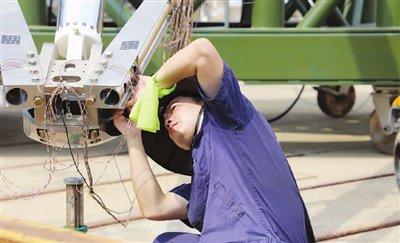
On the test field, Master Shen worked in the scorching sun.
■Labor News reporter Zhu Lanying text/photo
Job popularity index: ★★★★★
Occupation: Strength Environmental Tester
Location: Shanghai Institute of Aerospace Precision Machinery
Character: Intensive Environmental Testing Technology Team
Temperature on the day of the interview: 38℃
In July, the temperature in Shanghai exceeded 38℃ for many consecutive days. At the outdoor test site of the Shanghai Institute of Aerospace Precision Mechanics, a special “physical examination team” is conducting strength requirements testing and demonstration of a type of development of a launch vehicle subsystem. At the test site near the periphery of the institute's compound, they need to complete the precision mounting of more than 100 sensors under the scorching sun and endure the “baking test” of high temperatures. This group of strength environmental testers, known as “aerospace quality inspectors”, is using their sweat to cast “reinforced steel and iron bones” for the spacecraft.
The sun above your head
“Do CT” the rocket parts
At 8 a.m., the test supervisor Pan Junming had already led the team to start the pre-work meeting. The task on that day was heavy: not only did the launch vehicle subsystem be tested outdoors, but also prepared for static tests for fuel storage tanks with a height of 8 meters and a diameter of 3.8 meters.
In the eyes of Master Shen, the intensity environment tester, these two tasks are actually quite fun: “When the sun is too big, you go into the factory to check the storage box; when the sun is slightly smaller, you will come out to apply a patch.” The “patch” he mentioned is a pressure sensor with a thin sensor as thin as a hair at the key points of the rocket parts. “It's like doing 'full-body CT' for it. These sensors are its nerve endings. After being pasted, we can test the data it sends back in the background.” Master Shen used a multimeter to detect while explaining.
The reporter saw at the scene that in conjunction with the “working equipment” produced in advance (special process equipment, a collection of manufacturing tools specially designed to achieve specific process requirements in the development of aerospace products), the launch vehicle parts stand in the outdoor test site. Facing this huge work “partner”, Master Shen often needs to climb up to work. As an old fitter who has been in the industry for 13 years, he skillfully tied the safety rope and resolutely climbed onto the 10-meter-high liftable and lowered mobile platform, and rolled between various parts. “The metal surface temperature in summer is over 50℃, but wearing gloves will affect the feel.” Master Shen's work clothes were soaked in sweat, his cheeks under the safety helmet were covered with sweat, and his hair on his forehead was already half wet, but he always stared at the sensor in his hand, as if the scorching heat around him had nothing to do with him.
Already used to it
The clothes are wet and dry
The static test of the fuel storage tank was carried out in a semi-open factory building at a height of 35 meters, with neither air conditioning nor elevators. “The floor here is too high, and it's useless to install air conditioners.” They often need to climb stairs to the corresponding height to do their homework. Master Shen joked while climbing the stairs that he and Pan Junming had already become “stair climbers” and could even walk on flat ground between the steep steel frames.
At present, this static test is still in the construction stage and has not officially begun. During the interview, Master Shen and Pan Junming walked a hundred meters to the warehouse and worked together to transport the heavy nitrogen tank. Under the scorching sun, the metal can is so hot that it burns, and every step is to “bake and test” the endurance. When they completed the task, their clothes were already wet. “(clothes) can be wet and dry several times a day, but I've been used to it for a long time.” Pan Junming said with a sweat on his face.
Whether it is climbing up or climbing up or carrying weights, these astronauts use sweat to interpret the weight of the word “habit” – that is the focus and calmness tempered in countless repetitions.
For perfect data
Continuously “adjust”
For the intensity environment test team, some unexpected emergencies are normal. Once, a signal abnormality in a certain channel was suddenly detected – Pan Junming immediately rushed into the test site for investigation, and finally found that a sensing line was soaked with condensed water vapor. As the last inspection process before the Rockets' “appearance”, their work largely directly determines the reliability and safety of space launches. “Just like a rocket launch, once the test is started, it cannot be stopped easily. Every step must be confirmed to be in place.” Pan Junming explained.
The reporter learned that the special nature of this position is that it may be one of the few existing jobs in the aerospace field that require long-term outdoor operations. Master Shen’s master, Master Qi, recently suffered mild heatstroke due to continuous high-intensity homework and was sent home to rest by his colleagues. Before leaving, he said, “Change the parameters again and you can get perfect data.” This almost stubborn rigor and seriousness was also inherited by Master Shen – breathing should be lighter when applying the patch, for fear of affecting the data, because “a slight vibration may make the entire experiment meaningless.”
It is understood that this team, with an average age of only 35 years old, has to complete more than 300 high-intensity tests every year. “No mistakes are allowed, otherwise the entire project may be in vain.” Master Shen suddenly became serious. Although there is no spotlight, the intensity environment testers are always standing in the last shift before the spacecraft moves towards the launch tower. Their work clothes were wet and dry, and the multimeter in their hands measured tens of millions of data. The awe of the experiments may be the cornerstone of the hardest quality of China's aerospace industry.