
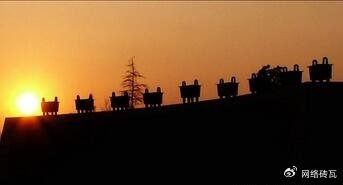
In ancient times, the tripod was originally just a common container made of pottery or copper for cooking food. Later, because our ancestors used it to serve the flesh to worship the gods of heaven and earth, they were given a sacred meaning and differentiated from daily necessities. In class society, the tripod further became a powerful tool that marked the power of the state to rule. The “Nine Tributes” (that is, nine large tripods made of bronze.) in this article are symbols of royal power and treasures for the three dynasties of Xia, Shang and Zhou dynasties in my country. In terms of its craftsmanship and value, it is undoubtedly much greater than any bronze ware unearthed today. But what makes people deeply regret is that such a precious national treasure was missing more than 2,000 years ago! How did the “Nine Cauldrons” disappear? This is really a confusing historical mystery.
As early as the beginning of the establishment of the Xia Dynasty, in order to cast the Nine Cauldrons, the King of Xia ordered the local chiefs of the nine states under his rule to be responsible for collecting bronze, contributing to the Xia royal family, and casting objects that represent the nine states on the tripod to symbolize that the nine states in the world gathered in the center of the Xia Dynasty. The so-called “Yu collected the gold of the nine herds, cast the nine tripods, and looked like the nine provinces.” (“Records of the Grand Historian: Emperor Wu's Chronicle”) is about this. The Xia Dynasty began with Yu. When it was passed down to Lai, it was destroyed by Cheng Tang because of Jie's confusion and incompetence. Cheng Tang was the first king of the Shang Dynasty. According to legend, after he destroyed Xia, he moved the Nine Cauldrons of Xia to Shangyi. When the Shang Dynasty was promoted to the king, it lost the hearts of the people because of tyranny. King Wu of Zhou took the opportunity to raise an army to attack Feng, and after destroying Shang, he returned to the west with the Nine Tripods of the Shang Dynasty. Soon, King Cheng, the son of King Wu, moved the Nine Dings to Haojing (now the outskirts of Xi'an) and held Longyu's “Dingding” ceremony, which meant the establishment of the new royal power. Therefore, later generations called the establishment of a regime called “determining the tripod”.
During the Spring and Autumn Period, as the power of the Zhou royal family gradually declined, the powerful princes developed a beautiful heart towards the Nine Tripods. In 606 BC, King Zhuang of Chu took advantage of the opportunity of the northern expedition of Luhun Rong to disguise his troops on the eastern border and show off his military power. King Ding of Zhou hurriedly sent the doctor Wang Sunman as an envoy to visit him. King Zhuang of Chu asked Wang Sunman about the “small and small” of Zhou's Nine Cauldrons with ulterior motives, implying that he was ready to seize Zhou's rule. Seeing that the other party was ambitious, Wang Sun replied tit-for-tat: “It is virtue but not the tripod.” “Although Zhou virtue has declined, the destiny of heaven has not changed, the importance of the tripod is not questionable!” (“Zuo Zhuan” in the third year of Xuangong.) It means: Although the Zhou royal family declined, it can still be maintained and is still the co-lord of the world, warning King Zhuang of Chu not to have any inappropriate ideas. Therefore, later the people compared “competing for the throne” to trying to seize power or plotting for the throne, etc.
By the late Warring States Period, the Zhou royal family was in a state of name and death, and major powers such as Qin and Qi often fought for the Zhou royal family to meet each other. In 254 BC, Qin destroyed Zhou. “Records of the Grand Historian: The Basic Annals of Qin” says: During the reign of King Zhao of Qin, “the people of Zhou fell from the east, and a total of nine tripods entered Qin”, and fell into the hands of the King of Qin. However, “Records of the Grand Historian: Fengshan Book” says: “Qin destroyed Zhou, and the nine tripods of Zhou entered Qin, and some say that the Taiqiu Society of Song Dynasty was destroyed, and the tripod was destroyed under Pengcheng, Sishui.” Obviously, there are two opinions on the whereabouts of the nine tripods. One is that the nine tripods were taken away when Qin destroyed Zhou, and the other is that the nine tripods sank before Qin destroyed Zhou. “Records of the Grand Historian: The Basic Annals of Qin Shihuang” also records this thing: In the 28th year of Qin Shihuang (219 BC), in order to find the Zhou Ding, Qin Shihuang was passing by Pengcheng on a tour, “fast, praying to the temple, and wanted to come out and sprinkle water, so that thousands of people could not get it without water.” Qin Shihuang's move shows that the rumors that the tripod entered the Si River must have been quite popular at that time, so even Qin Shihuang believed it, but the result was that “the bamboo basket is fetching water”. It seems that the exact whereabouts of the tripod can no longer be found from the relevant records in “Records of the Grand Historian”. Although some ancient books after “Records of the Grand Historian” also have records of the whereabouts of the tripod, they basically explain or supplement the two statements of “Records of the Grand Historian”. For example, “The Chronicle of Qin” says: “In the 19th year of King Shu of Zhou (296 BC), King Zhao of Qin took nine tripods, one of them flew into Si River, and the other eight entered Qin.” “The Book of Han: Sub-Sacrificial Records” says: In order to prevent the powerful country from seizing the tripod and solving its own economic difficulties, the Zhou royal family destroyed the tripod and minted money, and to the outside world it said that the nine tripods were unknown whereabouts, etc. Although these statements are thought-provoking, they are difficult to believe because they are unreasonable or insufficiently based.
There was a trend of looking for the “Zhou Ding” during the Qin and Han Dynasties. Qin Shihuang’s search for Zhou Ding has been described in advance. In the Han Dynasty, Emperor Wen of Han and Emperor Wu of Han continued to search for Zhou Ding. It is said that during the reign of Emperor Wu of Han, the Zhou Ding that “flyed into Si Shui” was found in Fenyang. But “the tripod is inscribed without any clues” is Zhou Ding? It is really hard to determine. So, where did the Nine Cauldron go? Are there any possibilities for finding it in the future? It depends on the progress of the archaeological excavation industry. If the Nine Cauldron has not been destroyed, perhaps one day, we or our descendants will have the honor to see the glory and “appearance” of this thousand-year-old treasure tripod from the unearthed cultural relics.