
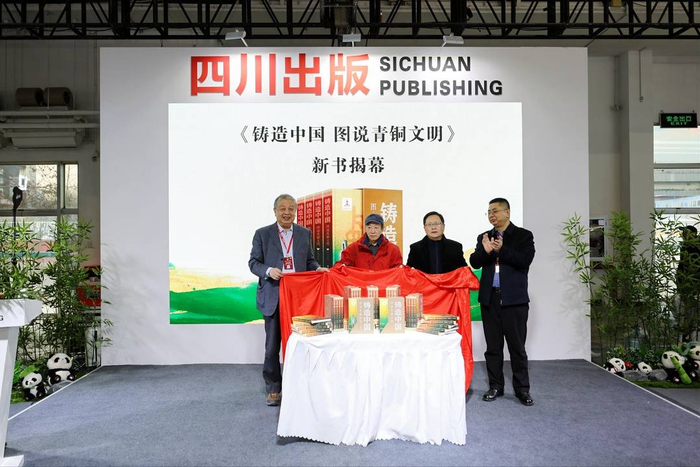
Cover news reporter Zhang Jie reporting from Beijing
Bronze is not only a symbol of Chinese civilization, but also an epic cast on metal. With its exquisite craftsmanship and profound cultural connotation, it runs through ancient and modern times and continues to bear witness to the distinctive characteristics of continuity, innovation, unity, inclusiveness and peace of Chinese civilization. In order to systematically sort out the context of bronze civilization and deeply display the long history of Chinese culture, Sichuan Education Press teamed up with interdisciplinary authoritative experts and relied on cutting-edge achievements in archeology, history, casting materials science, etc., and spent five years painstakingly compiling it to launch the National Publishing Fund project “Casting China Illustrated Bronze Civilization”.
On the morning of January 9, 2026, “Forging the Soul of Civilization and Passing on the Beauty of Bronze – “Casting China Illustrated Bronze Civilization” new book launch conference” was held at the Beijing Book Ordering Fair. Although Professor Liu Xingshi, the editor-in-chief of the book and a famous science fiction writer, could not be present in person, he still reviewed the origin of the compilation through a video speech. In particular, he interpreted the deep connection between bronze casting and the evolution of civilization from the perspective of ancient climate and environmental changes, and deeply remembered the honorary editor-in-chief Mr. Tian Changhu. Liu Rongsheng, one of the authors and an expert in materials science, explained the meaning of the title of “Casting China” and emphasized that the book focuses on the Xia, Shang and Zhou dynasties to systematically reveal the key role of bronze smelting in the formation of Chinese civilization.
The book is divided into four volumes: “Central Plains”, “Bashu Starlight”, “Jingchu Splendor” and “Wuyue Vicissitudes”. It selects four representative historical and civilized regions of the Central Plains, Bashu, Jingchu and Wuyue to give a panoramic introduction to the Chinese bronze civilization symbolized by bronze ware, and systematically demonstrates the continuity, innovation, unity, inclusiveness and peace of Chinese civilization. Relying on archaeology, history, casting materials science and other achievements, the book introduces the origin, characteristics, development, influence, inheritance and other contents of Chinese bronze casting. It also describes the diverse, integrated and inclusive characteristics of the mutual learning between the Central Plains and Bashu, Jingchu, Wuyue and other regional cultures, and objectively describes the Qing Dynasty. The relationship between copper casting and the development of Chinese civilization reveals the key role of bronze in national governance, technological dissemination and the isomorphism of Chinese culture, as well as its historic role in the development of science and technology, social progress, and national prosperity. It shows the brilliant scientific and technological achievements created by the Chinese ancestors from multiple angles.
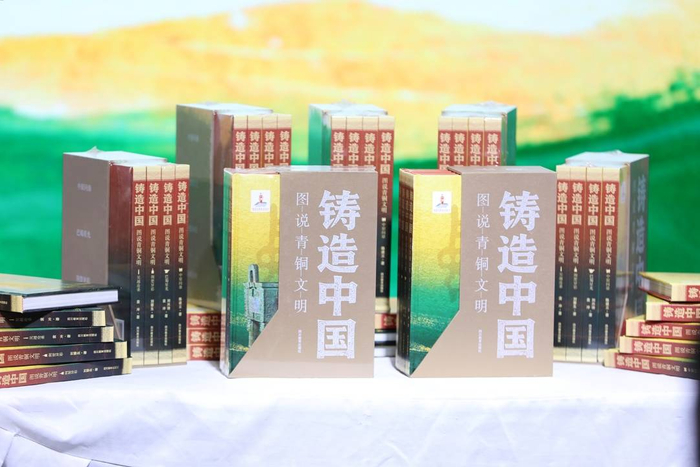 “Forging China”
At the same time, this book incorporates classic stories through the three major artistic elements represented by bronze casting and bronze objects, with professional narration and vivid expressions. It is accompanied by nearly 500 high-definition physical pictures, making it highly readable. At the academic level, the book runs through a multi-disciplinary perspective and provides an in-depth analysis of how bronze casting promoted the progress of ancient society and the prosperity of the country; in terms of readability, with the help of rich images and narratives, the cold bronze “speaks” and guides readers into the scene of civilization.
At the press conference, Wang Huaming, an academician of the Chinese Academy of Engineering, affirmed the academic value and dissemination significance of the book through a video, and pointed out that bronze technology research still has implications for contemporary materials science. Chen Jianli, a professor at the School of Archeology and Museology at Peking University, explained the overall promotion of bronze technology on ancient politics, economy and culture from an archaeological perspective. In his sharing, Yuan Chong, an expert from the Expert Committee of the China Foundry Association, paid tribute to the contributions of previous scholars and admitted that the writing process was a cultural tracing with a deep “local feeling”, which resonated with the audience present.
(Photo according to Sichuan Education Press)