

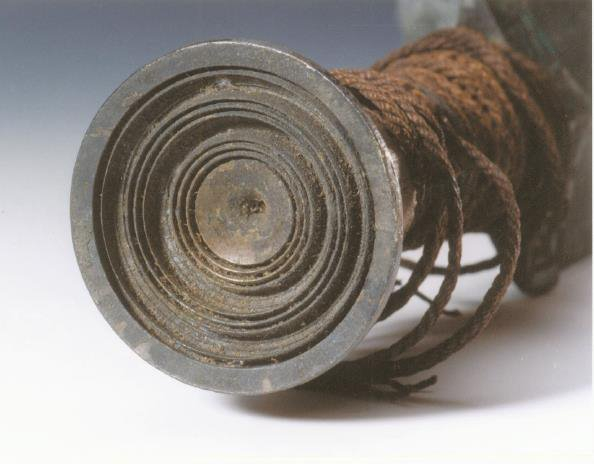
 Bronze sword head from the Warring States Period, collected by the Shanghai Museum
The development of Chinese bronze weapons reached the Eastern Zhou Dynasty. Due to the needs of princes competing for hegemony, the shape and production technology of weapons made significant progress. The weapons and technology of Wu and Yue are even more famous all over the world, which can be seen from the Goujian Sword of Yue King and Fuchai Spear of Wu King that were unearthed one after another. The sixth lecture of the fifth season of the Shanghai Forum, a public welfare cultural brand jointly created by the Shanghai Museum and Xinmin Evening News, will be given by Lian Haiping, a researcher at the Shanghai Museum, with the theme of “Three Wonders of Wuyue Bronze Technology in the Eastern Zhou Dynasty”. It will start at 19:00 on January 16 and will be broadcast live through the video account “Shanghai Moment”, the video account “Shanghai Museum”, Sina Weibo “Shanghai Museum”, and the Shanghai Museum Station B live room.
The sword of King Goujian of Yue (see picture on the left) was unearthed in 1965 from a Chu tomb in Jiangling, Hubei Province, the former territory of Chu State. There is an 8-character bird seal inscription on the sword: “King Goujian of Yue made his own sword.” The spear of King Wu Fu Chai was unearthed in Tomb No. 5 in Mashan, Jiangling, Hubei Province in 1983. The spear has an 8-character embossed gold inscription on it, “King Fu Chai of Wu made his own spear.”
The exquisite weapons of Wu and Yue often use various decorative techniques, such as concentric circles on the sword head, staggered gold and silver, gilding, inlaid gems, bright spots, tiger spots, fine openwork, flame patterns, rhombus patterns, etc., which are often described in ancient books. The “bronze composite sword technology”, “rhombus pattern technology” and “sword head concentric circle technology” can be called the three unique technologies of Wuyue bronze weapons.
Ancient Chinese craftsmen during the Eastern Zhou Dynasty produced a bronze composite sword in which the spine and two blades were cast from two components of bronze. The spine was made of low-tin bronze, which has high tensile strength and elongation, making the entire sword very flexible and difficult to break in combat. The blade was made of high-tin bronze, which has high hardness and can produce a sharp edge, which can play a better slashing role in combat, thereby achieving excellent comprehensive mechanical properties that cannot be achieved by single bronze. This is evidence that ancient Chinese craftsmen had a deep understanding of the relationship between the composition and properties of bronze alloys.
There is still no conclusion about the composition, structure and formation process of rhombus ornamentation. The surface treatment technology of rhombus-shaped weapons is to use a certain method to form regularly distributed tin-rich surface dendrite areas on the surface of the cast bronze sword.
The concentric circles on the sword head are located at the end of the sword head. Some sword heads have as many as 11 concentric ridges. On the bottom of the grooves of multiple circles of concentric circles, there are extremely fine raised rope patterns, which increases the beauty and decoration of the sword head concentric circles. Such fine and tight thin-walled concentric circles make this kind of sword head impossible to achieve with modern mechanical processing methods. This proves that more than 2,500 years ago, our country had mastered extremely precise casting and forming technology. Our reporter Xu Yisheng