
Source: Meow Meow Meow
A golden treasure that had been sleeping in a field for hundreds of years unexpectedly revealed the true imprint of a legendary king in England's history. According to the popular science website “Live Science”, this rare cultural relic called “The Alfred Jewel” is about 1,100 years old. There is an imposing Old English inscription engraved on its edge: “Alfred ordered me to be made,” directly connecting it with Alfred the Great, known as the “first king” in England's history.
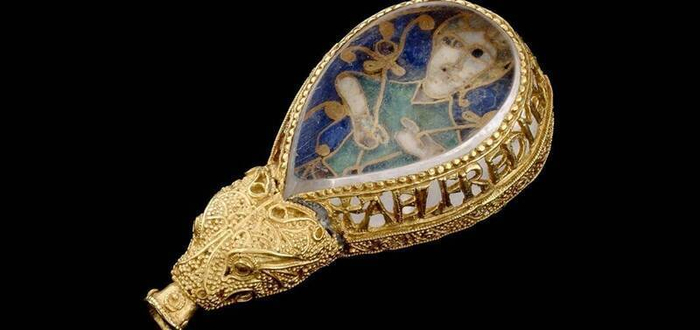
“The Alfred Jewel” collected in the Ashmolean Museum of Oxford University has a history of more than 1,100 years. This 9th-century gold and enamel treasure, with the inscription “Avery commanded me to be made” engraved on the edge, has been confirmed to be related to the first king of England. (Picture taken from Ashmolean Museum)
This golden artifact was first discovered in 1693. At that time, a farmer accidentally dug it up while plowing in Somerset, southwest England. The gemstone is approximately 6.2 cm long and 3.1 cm wide. It uses extremely sophisticated filigree enamel techniques to fill colored enamel into fine grids separated by gold. The outer layer is also covered with a drop-shaped crystal, making the overall look gorgeous and solemn.
The most eye-catching is the Old English inscription inlaid on the gold frame: “AELFRED MEC HEHT GEWYRCAN”, which means “Alfred ordered me to be made.” This line of text is regarded as irrefutable evidence, pointing the artifact directly to Alfred the Great, who resisted the Viking invasion in the 9th century and laid the foundation of England's royal power.
Luxurious “reading artifact” with hidden slot at the bottom
What is the purpose of such a precious treasure? Scholars generally believe that it is likely to be the decorative handle of an “aestel” (reading pointer). Alfred the Great was not only a military commander, but also a monarch who valued education and scholarship. He vigorously promoted the translation of Latin religious texts into Old English.
According to records from the Ashmolean Museum of Oxford University, Alfred gave these translations to bishops around the world, and included a beautifully made and expensive reading pointer with the book to assist reading and mark text spacing.
Researchers found a slot structure shaped like the mouth of a dragon or snake at the bottom of the gemstone, and speculated that a slender ivory or wooden pointer was originally connected here. As time goes by, the pointer body has decayed and disappeared, leaving only this gorgeous gold gem that looks like a “dragon head”.
The land has a special meaning and was once a refuge for kings
The location where this gem was found is also full of history. It was unearthed near Athelney Abbey, which was originally a small defensive stronghold. Historical records indicate that in 878 AD, Alfred the Great hid here for several months before launching a counterattack and defeating the Danish Vikings.
After the victory of the war, he built a monastery here. This gem was most likely a royal artifact or gift left at that time. Today, the “Alfred Gem” is regarded as one of the most important and symbolic relics of royal power in the UK, quietly telling the intertwined history of royal power, faith and culture thousands of years ago.
Read more:
EU: Conditions for contact with Putin on Ukraine are not yet mature
Estonia plans to adjust drug sentencing: lenient for users and stricter for drug traffickers
Serious scandal involving sexual harassment, extremism and drugs in Germany's elite paratroopers
Compilation link: https://news.ltn.com.tw/news/world/breakingnews/5308019