
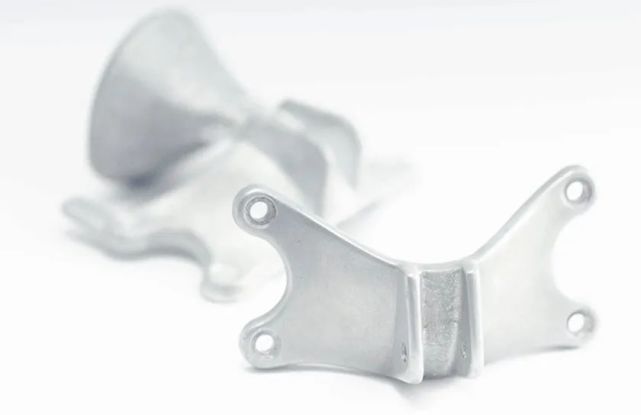
Antarctic Bear learned that Foundry Lab, with the support of venture capital firm Blackbird Ventures and Rocket Lab CEO Peter Beck, has developed a digital microwave casting technology that makes it possible to deliver metal castings on the same day. According to Foundry Lab, digital metal casting (DMC) technology can be applied in large-scale manufacturing industries that metal 3D printing is currently unable to achieve. DMC can combine the freedom of metal 3D printing with the production speed and economy of metal casting.
△Foundry Lab’s metal stent manufactured by DMC technology. Photo from Foundry Lab.
Foundry Lab CEO and founder David Moodie said that 3D printing is very suitable for making similar-looking parts, but metal printing can never produce real castings, and they can work at the speed that 3D printing can dream of.
Foundry Lab’s DMC technology
Metal 3D printing is slow and expensive due to limited materials and high prices; CNC machining is limited in shape and will generate a lot of waste. Therefore, metal casting is an ideal large-scale manufacturing method, but the high cost prevents this technology from being used for the production of fewer than thousands of parts. Current existing casting processes, such as investment casting, 3D printing sand molds, and die casting, usually require one to six weeks of production time. Some companies will outsource castings to foundries, which may cause delays in the development cycle, and many non-cost-effective castings will not be produced in the short term.
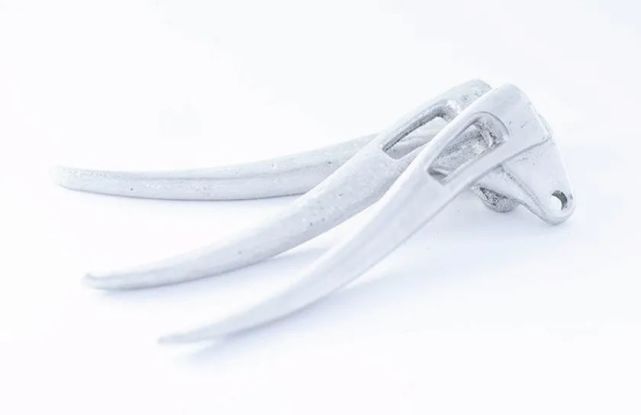
△Foundry Lab’s metal brake lever manufactured by DMC technology. Photo from Foundry Lab.
In this regard, Foundry Lab is trying to use DMC technology to overcome the speed, simplicity and cost limitations of current metal casting technology. In order to solve the shortcomings of each casting technology, Foundry Lab has developed microwave DMC technology, which enables users to automatically generate parts for multiple components from CAD files in one day. According to reports, it combines the geometry and design freedom of 3D printing with the production speed and economy of metal casting parts.
Foundry Lab has not released details about the working principle of DMC, but it clearly stated that this technology is adapting to the existing development workflow and has no special design requirements. The company describes the DMC-Office System as a combination of hardware and software products that can achieve hands-free metal casting equivalents without pouring molten metal. In addition, the system is currently compatible with aluminum, magnesium, zinc, stainless steel and cast alloys, producing completely dense parts. The physical properties of the parts are “functionally equivalent” to those produced by traditional metal casting technology. According to Foundry Lab, the post-processing of parts produced by DMC is comparable to die casting.
Budding
In order to prove that the DMC system enables users to make metal parts with any cast alloy so as to perform functional tests before mass production, Foundry Lab completed the process from CAD files to the production of cast aluminum brake pads in less than 8 hours.
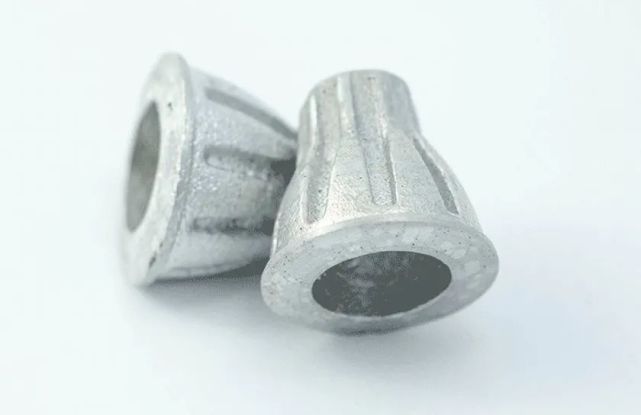
△Metal LED manufactured by Foundry Lab’s DMC technology. Photo from Foundry Lab.
In addition, Foundry Lab also announced on November 29, 2021 that it has completed a US$8 million Series A financing, which has been supported by global and New Zealand investment leaders such as Blackbird, GD1, Founders Fund, Promus Ventures, WNT Ventures, Icehouse, and K1W1. . Karl Iagnemma, CEO of Motional, a self-driving car company, and Carl Bass, former CEO of AutoDesk, also expressed support for the company. This financing will enable the company to expand its team and seek talent in the fields of radio frequency and microwave engineering, mechatronics, and mechanical, analog, and software engineering.
Ian Howe, CEO of 3D printer manufacturer Additive Industries, once said that reducing the cost per kilogram is the biggest challenge facing the industry. Only by improving machine productivity and cost-effectiveness can we really promote the penetration of metal 3D printing into industrial-scale applications.
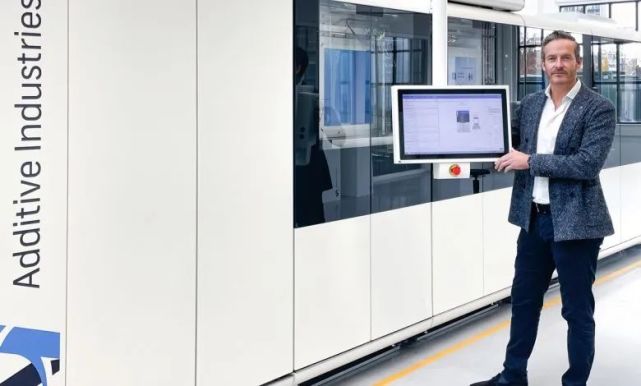
△Additive Industries CEO Ian C. Howe uses MetalFAB1 system.
Combining 3D printing and casting manufacturing processes may be able to manufacture molds at lower cost and higher efficiency. For example, 3D printed molds have been used to produce transparent dental braces and hearing aids. Many companies such as 3D Systems, voxeljet and Soliscape have also released 3D printers designed for casting and molding applications. For example, 3D Systems’ ProJet MJP 2500W and the new red wax material VisiJet Wax Jewel Red create possibilities for complex jewelry casting.
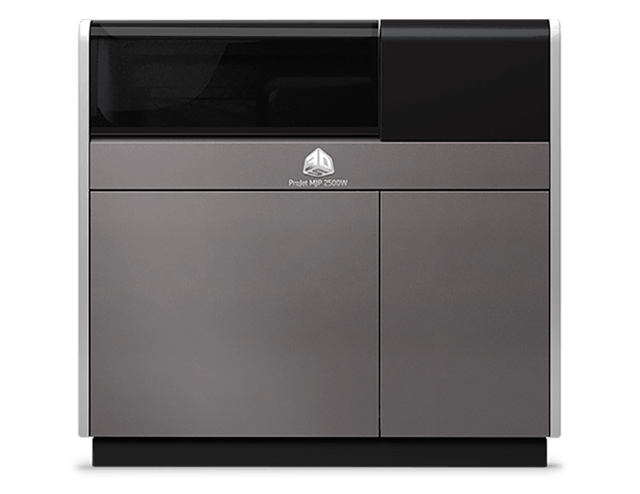
△ProJet MJP 2500W
In addition, a potential competitor of Foundry Lab, the British metal 3D printing service Enable Manufacturing launched a vacuum additive casting process in early 2021, claiming that it can manufacture metal parts at a fraction of the cost of direct metal 3D printing. This technology is based on a hybrid method of 3D printing molds and casting parts patterns, combined with vacuum casting technology to draw metal into fine structures, and can produce more than 130 different metal parts at a lower cost than metal 3D printing and traditional manufacturing processes.