
China News Service, Luoyang, December 7th, Title: “The First Lord of China” Reveals the Resurrection of Bronze Civilization's AR Technology of Casting Techniques 3,600 Years Ago
Author Wang Yu
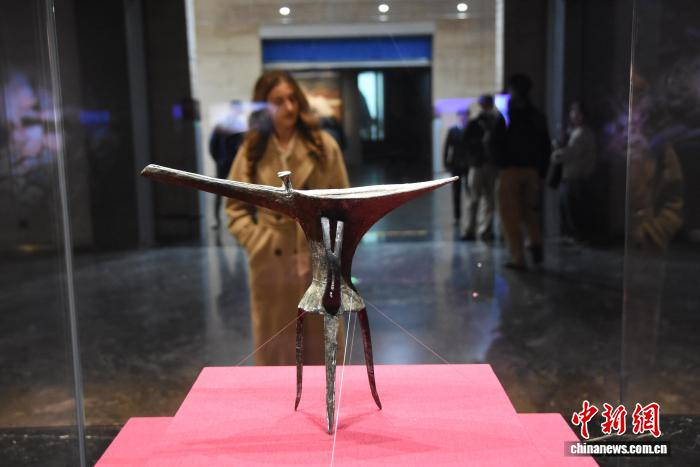
On December 7, in the Erlitou Xiadu Ruins Museum in Yanshi, Luoyang, Henan, a bronze figure with a breast nail pattern that resembled a “small waist” attracted many tourists to stop and look at it.
This bronze knight with breast nail pattern is the “treasure of the museum” in the Erlitou Xiadu Ruins Museum. The jue was unearthed in 1975, with a height of 26.5 cm and a total length of 31.5 cm. It is one of the earliest bronzes discovered in China and is known as the “No. 1 Jue of China”.
Since the Erlitou Xiadu Ruins Museum opened in 2019, it has received more than 7 million visitors. Among them, the Bronze Lord is like a “super star”, and his popularity has never diminished.
Zhao Haitao, leader of the Erlitou working team of the Institute of Archeology of the Chinese Academy of Social Sciences, said in an interview with China News Service that the bronze baron was cast about 3,600 years ago. It not only rewrote the history of Chinese bronze civilization, but also pushed the origin of Chinese ritual traditions to the late Xia Dynasty.
Zhao Haitao said that there are many peculiarities about this bronze jue: first, if you look closely at the “small waist” part of the bronze jue, you can see five breast nail patterns arranged horizontally.
“As one of the simplest patterns in bronze, the breast nail pattern carries not only aesthetic interest, but also a set of etiquette symbols that are gradually taking shape.” Zhao Haitao pointed out that it is not only a gratitude to the mother for nurturing life, but also expresses the ancestors' awe and worship of the origin of life. It also implies the Xia Dynasty ancestors' simple understanding of natural forces such as heaven and earth, yin and yang.
Secondly, there is a raised “fan line” on the side of the bronze jue. This seemingly ordinary trace is actually key evidence that the Erlitou period mastered the composite mold casting technology.
The so-called composite mold is to put a core in the clay mold, and then pour copper liquid into the gap between the outer mold and the core.
“The moment when the copper liquid was injected, the Chinese Bronze Age truly began, demonstrating unique originality.” Zhao Haitao said that this technology made it possible to produce bronzes with more complex shapes and larger volumes, and also became the source of the term “model” for later generations.
The famous German sinologist Redhou once highly praised this technology: “It is a complete and mature system that perfectly integrates design and casting technology.”
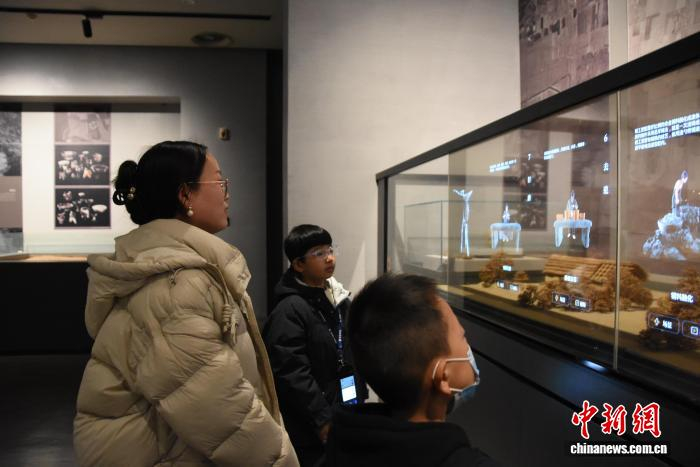 On December 7, at the Erlitou Xiadu Ruins Museum in Yanshi, Luoyang, Henan, the audience used digital technology to watch the scene of craftsmen making copper lords with nipple patterns 3,600 years ago. Photo by Wang Yu
Today, the museum uses OLED transparent screens and augmented reality technology to transform the Bronze Jue into an interactive digital scene. By scanning the QR code on their mobile phone or wearing AR glasses, the audience can hold the digital copper baron in the palm of their hand and take a closer look. They can also witness with their own eyes the scenes of mold making, assembly, pouring, and polishing by craftsmen 3,600 years ago.
Thirdly, the design of the copper jute with breast nail pattern is full of wisdom and beauty, especially the double pillars with flowing mouth, which implies the etiquette of “temperance”.
Archaeological findings show that the Erlitou site is the earliest core city with clear planning in China and even in East Asia. This fully shows that the Erlitou culture produced the earliest kingship and royal state, and has formed a dynastic ritual system unique to the political civilization of ancient China.
“This bronze jue is probably not an everyday drinking vessel.” Zhao Haitao pointed out that after the Erlitou ancestors mastered the advanced copper casting technology, they first used it to make ritual vessels, which reflected the early practice of “the major affairs of the country are sacrifices to the Rong” and was also a vivid testimony that the Xia people attached great importance to ritual sacrifices. It carries the civilizational genes of the “ritual and music system” and is the glorious beginning of the bronze ritual and music civilization in the Central Plains. It also laid the core foundation for the bronze civilization of the Shang and Zhou dynasties.
Nowadays, Bronze Jue with breast nail pattern is continuing its life with a new attitude. The museum emblem draws on its shape and uses the strokes of the word “Xia”, which not only highlights the characteristics of Xia culture, but is also full of modern beauty. (over)